A camera strobe is a high-intensity flashing light built into or paired with a security camera that activates when motion or an intrusion is detected. The goal is to startle and deter trespassers before they can cause damage or theft. On construction jobsites, where tens of thousands of dollars in materials and equipment sit exposed after hours, camera strobes paired with audible sirens have become one of the most effective active deterrent tools available.
KEY TAKEAWAYS
- Camera strobes are flashing lights that activate on detection events to deter intruders in real time.
- Paired with sirens, they create an active deterrent system that goes beyond passive recording.
- Construction jobsites are high-theft environments, and active deterrent cameras reduce risk without requiring a guard on-site.
- TrueLook’s TrueShield and TrueDeter solutions combine HD cameras, strobe lights, and sirens for 24/7 jobsite protection.
- Active deterrent systems work best when integrated into a broader jobsite visibility and monitoring platform.
What Is a Camera Strobe?
A camera strobe is a bright, rapidly flashing light integrated into or mounted alongside a security camera. When the camera’s motion detection or AI-based detection system triggers an alert, the strobe activates, often alongside a siren or two-way audio, to visually warn and disorient potential intruders.
Unlike standard security cameras that only record after-the-fact evidence, a camera with a built-in strobe is designed to stop a crime while it’s happening. The strobe’s intensity is intentional: bright, disorienting flashes at night signal to a trespasser that they’ve been seen and that a response is coming. Most active deterrent cameras pair the strobe with a loud siren for maximum effect.
On construction jobsites specifically, strobe cameras are typically mounted on portable mast systems or temporary structures, pointed at perimeter entry points, material staging areas, and equipment yards, wherever theft risk is highest after the crew goes home.
Do Security Cameras Have Strobes Built In?
Not all security cameras have strobes, but active deterrent cameras do. Standard IP cameras and basic construction cameras are passive: they record and, in some cases, send motion alerts to a user’s phone or desktop app. What they don’t do is react to an intrusion in real time.
Active deterrent cameras like TrueLook’s TrueShield and TrueDeter are purpose-built with integrated strobe lights and sirens. When a detection event triggers, whether from AI-powered motion classification or a monitoring team, the strobe fires, the siren blares, and if a live agent is watching, a voice warning is broadcast through the camera’s two-way audio. The result is a layered response that passive cameras simply can’t deliver.
For construction project managers running multi-site operations, the difference matters. A camera that only records means reviewing footage after a theft. A camera with a strobe means stopping the theft from happening.
How Does a Strobe Deterrent Camera Work?
Here’s the typical sequence when a strobe deterrent camera activates on a jobsite:
- Detection trigger — AI-powered motion classification or a monitoring operator identifies a person or vehicle in a restricted area after hours.
- Strobe activation — High-intensity flashing lights fire immediately, signaling to the intruder they’ve been detected.
- Siren activation — A loud audible alarm sounds simultaneously, drawing attention and increasing the psychological pressure to leave.
- Voice challenge — On monitored systems, a live agent or pre-recorded message warns the intruder over two-way audio (“You are being recorded. Leave immediately. Authorities have been contacted.”).
- Alert dispatch — The system notifies the site owner, project manager, or security contact in real time, with the option to escalate to local law enforcement.
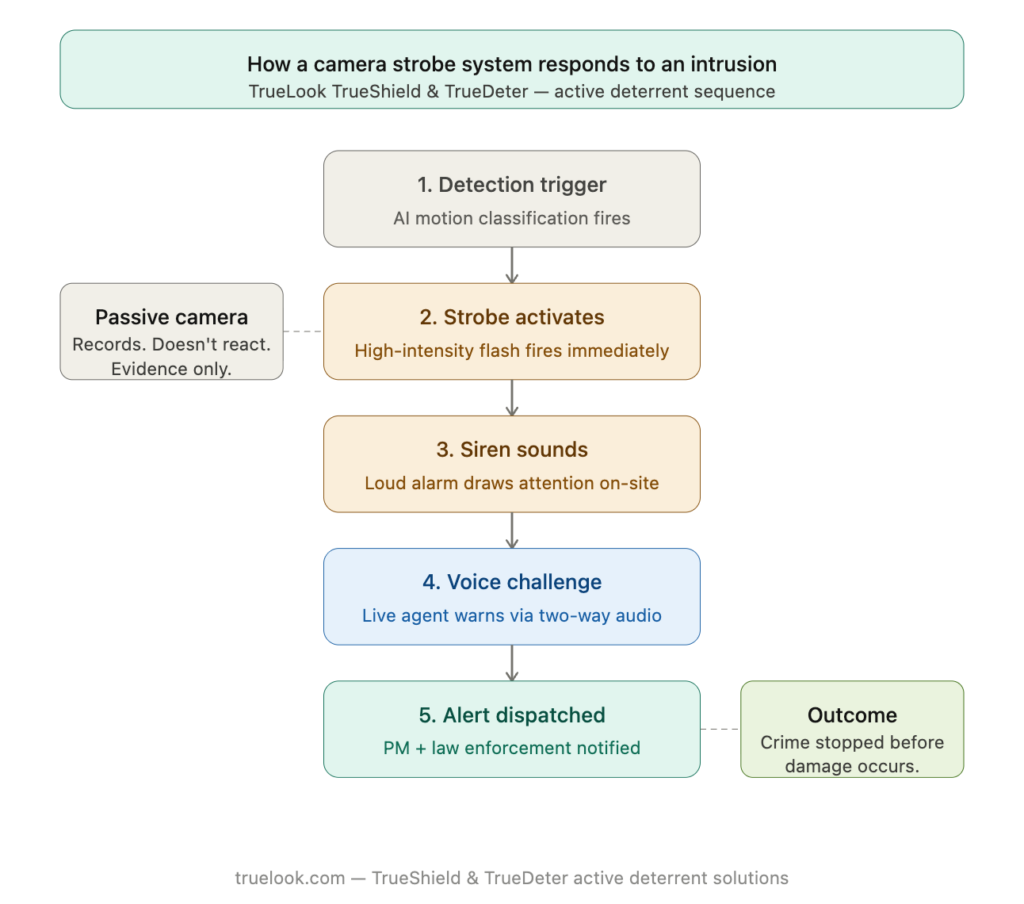
This sequence is designed to resolve the situation before damage or theft occurs, not just document it afterward. For general contractors managing overnight material storage or equipment yards, this kind of response chain is the difference between a close call and a police report.
What Is the Difference Between a Camera Strobe and a Camera Siren?
A camera strobe is a visual deterrent or a flashing light designed to startle and disorient. A camera siren is an audible deterrent or a loud alarm that draws attention and signals detection. Both serve the same goal: to make the intruder aware they’ve been seen and that staying is a bad idea.
The most effective active deterrent cameras combine both. Strobe-only systems can go unnoticed in well-lit areas or by intruders who are far from the camera. Siren-only systems can be ineffective if the site is remote or the intruder is wearing hearing protection or simply unfazed by noise. Together, they create a multi-sensory response that’s harder to ignore.
TrueLook’s TrueShield and TrueDeter solutions deploy both strobe and siren in a unified system, controlled through the same platform project managers already use for live HD viewing, time-lapse documentation, and multi-site monitoring. You don’t need a separate security platform. The deterrent layer is included inside the same dashboard you use to run your projects.
Why Are Camera Strobes and Sirens Important for Construction Sites?
Construction jobsites are among the most targeted environments for theft and vandalism. Open perimeters, predictable after-hours schedules, and high-value materials, such as copper wire, lumber, HVAC units, and heavy equipment, make them easy targets. The National Equipment Register has noted that construction theft costs the industry billions annually. Our research shows that most incidents happen between 11 pm and 3 am on weekends when crews aren’t present.
Traditional security approaches, such as chain-link fencing, padlocks, and generic CCTV, act as passive barriers. A determined thief bypasses them. Active deterrent cameras with strobes and sirens change the risk calculation in real time. When the lights start flashing and the siren fires, most intruders leave before anything is taken.
For project managers responsible for protecting materials between pours, during procurement delays, or across multi-phase builds, strobe and siren cameras offer something passive systems never can: the ability to stop a loss event while it’s happening, not just document it for an insurance claim afterward.
What Is TrueDeter, and How Does It Use Strobe and Siren Technology?
TrueDeter is TrueLook’s active deterrent camera system, purpose-built for construction jobsite security. It combines HD live video, AI-powered motion detection, integrated strobe lights, and audible sirens, all connected through TrueLook’s 4G LTE cellular modem, so no jobsite WiFi is required to get it running.
When TrueDeter detects an intrusion event, the strobe and siren activate automatically. The system also feeds into TrueLook’s professional monitoring network, where live agents can issue voice warnings and escalate to law enforcement if needed. Project managers get real-time alerts directly to their phone or through the TrueLook dashboard.
Setup is plug-and-play — consistent with TrueLook’s broader camera line, customers report going live quickly. And because TrueShield runs on the same platform as TrueLook’s HD cameras and multi-site dashboard, project managers don’t need to juggle separate systems for visibility and security.
What Is TrueShield, and How Does It Differ from TrueShield?
TrueShield is TrueLook’s next-tier active deterrent solution, designed for jobsites that need more aggressive deterrence coverage. Like TrueDeter, TrueShield uses integrated strobe lights, sirens, and two-way audio, but it’s configured for broader coverage areas and higher-risk site profiles. TrueShield can also consist of up to three cameras, most commonly having a PTZ and two fixed cameras.
Both TrueShield and TrueDeter are part of TrueLook’s broader jobsite intelligence platform. That means the same system handling your live HD viewing, automated time-lapses for project documentation, PPE detection, and Procore or Autodesk Construction Cloud integrations also powers your after-hours strobe and siren deterrence.
For general contractors managing multiple active projects simultaneously, having jobsite security, remote monitoring, and documentation in a single platform, rather than four different vendor contracts, is a meaningful operational and cost advantage.
Can a Camera Strobe Actually Prevent Theft?
When implemented correctly, active deterrent cameras with strobes and sirens prevent theft in the moment; they don’t just document it. The difference is critical.
Passive cameras record evidence after the fact. Active deterrent cameras interrupt the crime. Studies of active deterrent deployments in commercial settings consistently show that visible strobes and sirens cause the majority of intruders to retreat before any theft or damage occurs. The psychological effect of a flashing light and loud alarm, especially paired with a live voice challenge, is difficult to override.
TrueLook’s security monitoring (in partnership with Noonlight) has helped catch criminals on active jobsites. The strobe and siren component means that many incidents are stopped before they escalate to a police call at all.
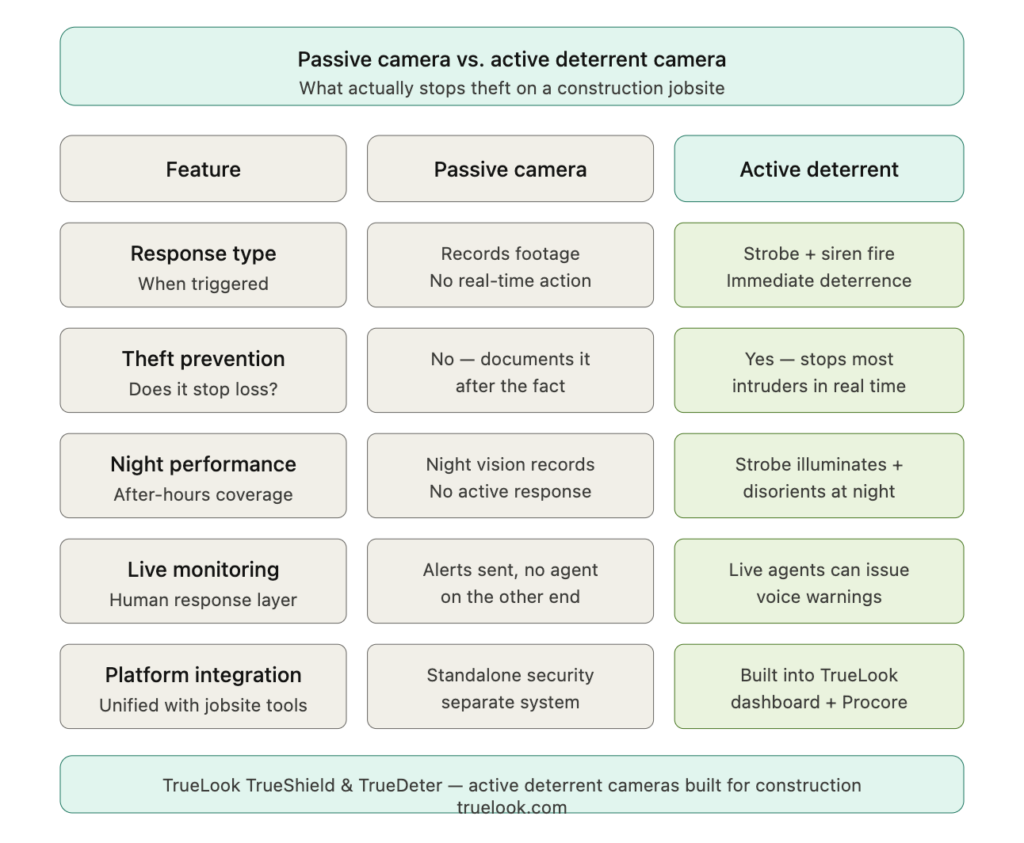
For construction project managers, the goal isn’t a better insurance claim; it’s not losing materials, not falling behind schedule because stolen equipment has to be replaced, and not spending project budget on losses that were preventable.
How Do I Choose a Camera with a Strobe and Siren for a Construction Jobsite?
When evaluating active deterrent cameras for construction sites, look for these capabilities:
- Integrated strobe and siren — not an afterthought add-on, but built into the camera unit itself
- AI-powered detection — reduces false alarms from wind, animals, or passing traffic so the strobe and siren fire when it matters
- Cellular connectivity — 4G LTE modem built in means deployment anywhere on site, not just near a network drop
- Professional monitoring option — live agents add a response layer that automated systems alone can’t provide, while reducing false alarms
- Unified platform — security features should live inside your jobsite visibility platform, not a separate system
- Easy deployment — construction sites move. Your security camera needs to move with them.
TrueLook’s TrueShield and TrueDeter check every one of these boxes. And because they’re part of TrueLook’s total jobsite intelligence platform, the same one project managers use for daily reporting, time-lapse documentation, and stakeholder sharing, you’re not bolting on a security tool. You’re activating a capability that was always part of the system.
A camera strobe is a high-intensity flashing light that activates when a security camera detects motion or an intrusion. On construction sites, it’s used to startle and deter trespassers in real time, before theft or vandalism occurs. Unlike a standard camera that only records, a strobe camera actively responds to the threat.
No. Most standard IP cameras and basic construction cameras are passive. They record footage and send motion alerts but take no active action. Only active deterrent cameras, like TrueLook’s TrueShield and TrueDeter, have integrated strobe lights and sirens designed to respond to intrusions automatically.
Construction-grade camera sirens typically output between 100 and 120 decibels, which is loud enough to be heard across a jobsite and to create strong psychological pressure for an intruder to leave. At that volume, the siren is effective even in outdoor environments with ambient noise from nearby traffic or equipment.
Yes. TrueLook’s TrueShield and TrueDeter systems include a built-in 4G LTE cellular modem, so they operate independently of jobsite WiFi. This makes them deployable anywhere on site, at perimeter entry points, material staging areas, or equipment yards, without requiring a network infrastructure to be in place first.
Lower-quality systems can trigger false alarms from wind, animals, or passing vehicle headlights. TrueLook’s active deterrent cameras use AI-powered motion classification to distinguish between genuine intrusion events and environmental triggers, significantly reducing false activations and ensuring the strobe and siren fire when it actually matters.
Both are TrueLook active deterrent camera systems with integrated strobe lights, and sirens. TrueDeter has one camera and no talkdown bullhorn. TrueShield has up to three cameras and includes a talkdown bullhorn, which makes it configured for broader coverage areas and higher-risk site profiles. Both run on the same TrueLook platform alongside live HD viewing, time-lapse documentation, and Procore and Autodesk Construction Cloud integrations.
Not with TrueLook. TrueShield and TrueDeter are part of TrueLook’s unified jobsite intelligence platform — the same dashboard project managers use for remote monitoring, daily documentation, and multi-site management. Security and visibility live in one place, not two separate vendor contracts.
TrueLook’s camera systems are designed for plug-and-play deployment. Customers consistently report going live in under five minutes. The built-in 4G LTE modem eliminates the need for network configuration, making setup fast enough to keep pace with a construction project’s changing site layout.
BOTTOM LINE
Camera strobes and sirens aren’t a nice-to-have for construction sites; they’re an active line of defense against the theft and vandalism that cost the industry billions every year. Passive cameras record. Active deterrent cameras respond. TrueLook’s TrueShield and TrueDeter solutions bring a camera strobe, siren, AI detection, and professional monitoring together in a platform built specifically for construction teams. If your jobsites are exposed after hours, it’s time to upgrade from recording losses to preventing them.
Talk to TrueLook about adding active deterrence to your camera deployment.