Key Takeaways
- Construction site surveillance combines cameras, sensors, and remote monitoring to protect equipment, prevent theft, and enforce safety compliance on active job sites.
- The average construction site loses $1,000–$3,000 per incident of equipment theft or vandalism — surveillance directly reduces that exposure.
- Modern systems use AI-powered video analytics to detect perimeter breaches, unauthorized access, and PPE violations in real time.
- Temporary, solar-powered, and trailer-mounted construction site surveillance cameras are the leading solutions for sites without permanent infrastructure.
- Construction surveillance integrates with access control, alarm systems, and GPS fleet tracking for a layered security approach.
- Site surveillance also serves as liability documentation — footage protects general contractors from false injury claims and OSHA disputes.
- Construction site surveillance camera systems typically range from $300–$1,500/month for monitored rentals to $2,000–$10,000+ for permanent installations, depending on site size and coverage needs.
What is construction site surveillance, and why does it matter?
Construction site surveillance is the use of cameras, motion sensors, alarms, and remote monitoring technology to protect an active job site from theft, vandalism, unauthorized access, and safety incidents. It matters because construction sites are uniquely vulnerable — they operate in open, often unsecured environments with rotating workforces and millions of dollars in unattended equipment.
Key reasons construction security is a priority:
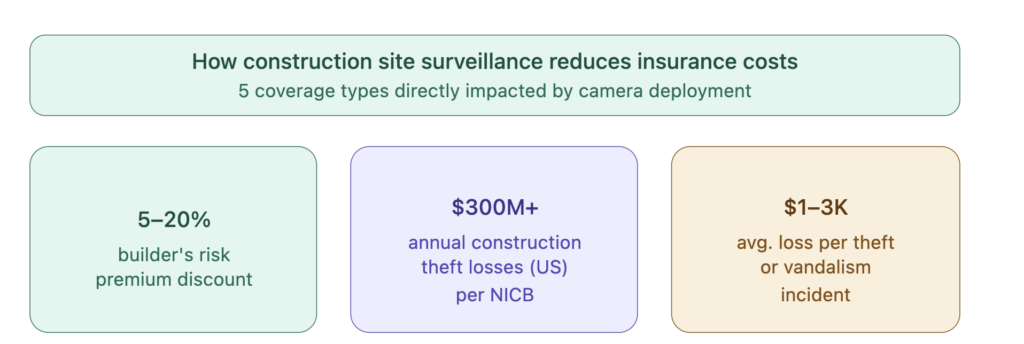
- Equipment theft costs the U.S. construction industry an estimated $300 million to $1 billion annually, according to the National Insurance Crime Bureau (NICB).
- Material theft — copper wire, lumber, and HVAC equipment — is rampant on sites between shifts.
- Safety liability — footage documents whether workers wore PPE, followed procedures, or were present during an incident.
- Subcontractor accountability — site owners and general contractors can verify when trades arrive, work, and leave.
- Insurance premiums — documented surveillance systems can qualify a project for lower commercial property and inland marine insurance rates.
Related organizations and standards:
- National Insurance Crime Bureau (NICB) — tracks construction equipment theft data nationally.
- OSHA (Occupational Safety and Health Administration) — mandates safety recordkeeping that surveillance footage can support.
- Associated General Contractors of America (AGC) — publishes site security best practice guidelines for members.
Types of Construction Site Surveillance Cameras
Construction sites use several construction site surveillance camera types depending on power availability, site duration, and coverage needs. The most common are solar-powered PTZ cameras, trailer-mounted units, and fixed-position cameras connected to cellular networks. Choosing the right type depends on whether the site has permanent power, how long it will run, and what events need to be captured.
Camera types at a glance:
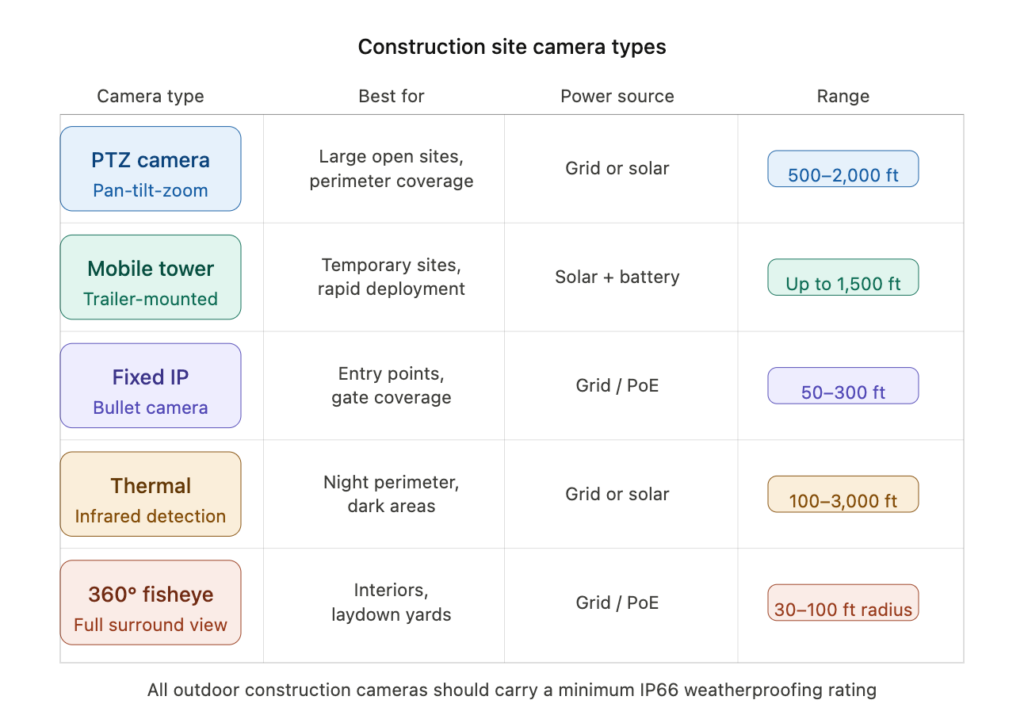
- PTZ (Pan-Tilt-Zoom) — Best for large open sites and perimeter coverage. Powered by grid or solar. Range: 500–2,000 ft.
- Trailer-mounted / mobile towers — Best for temporary sites and rapid deployment. Solar + battery powered. Range: up to 1,500 ft.
- Fixed IP / bullet cameras — Best for entry points and gate coverage. Grid power or PoE. Range: 50–300 ft.
- Thermal cameras — Best for nighttime detection and dark perimeters. Grid or solar powered. Range: 100–3,000 ft.
- 360° fisheye cameras — Best for warehouse interiors and laydown yards. Grid or PoE powered. Range: 30–100 ft radius.
Key considerations when selecting construction site surveillance cameras:
- Power availability — Sites without grid power rely on solar-charged lithium batteries. Sizing the solar panel to match camera uptime is critical.
- Connectivity — Most temporary construction cameras transmit via 4G LTE or 5G cellular rather than hardwired ethernet.
- Resolution — A minimum of 1080p (Full HD) is recommended for evidentiary footage; 4K is preferred for large coverage areas.
- Night vision — IR (infrared) illuminators cover up to 100 ft in total darkness; color night vision cameras require ambient lighting.
- Weatherproofing — Construction site surveillance cameras should carry an IP66 or IP67 rating to withstand rain, dust, and temperature swings.
How Much Does Construction Site Surveillance Cost?
Construction site surveillance costs vary significantly based on site size, camera count, power infrastructure, and whether the system is monitored. Here is a general breakdown to help with budgeting:
| Solution Type | Typical Cost Range for purchase | Typical Cost Range for lease |
|---|---|---|
| Fixed Camera | $1,000 – $9,000 / per camera | $100 – $600 / month |
| PTZ Camera | $5,000 – $7,000 / per camera | $300 – $400 / month |
| Surveillance Trailer | $25,000 / per unit | $1,000+ / month |
| Surveillance Solution (3 cameras, talkdown horn, strobes, sirens) | $7,000+ (not including trailer) | $400+ / per month (trailer not included) |
| On-site security officer (comparison) | N/A | $4,000 – $10,000 / month |
Key cost factors:
- Number of cameras and coverage area — A small residential site may need 2–4 cameras; a large commercial project may require 20+.
- Rental vs. purchase — Rental makes sense for projects under 18 months; purchase is more cost-effective for long-duration or repeat sites.
- Monitoring level — Unmonitored recording is the cheapest but provides no real-time deterrence; remote video monitoring adds cost but significantly reduces theft and false alarm rates.
- Power infrastructure — Sites requiring trenched conduit and electrical panels add $5,000–$20,000 in installation costs; solar-powered units eliminate that expense.
Many construction insurance carriers offer premium discounts of 5–20% for verified, centrally monitored surveillance systems — meaning the system can partially pay for itself through reduced coverage costs.
How AI-Powered Video Analytics Improves Construction Surveillance
AI-powered video analytics transforms passive camera footage into an active detection system that alerts site managers to specific events — such as perimeter breaches, PPE violations, or unauthorized vehicles — without requiring someone to watch live feeds around the clock. This dramatically reduces guard labor costs while increasing response speed to real threats.
Core AI capabilities used in construction surveillance:
- Perimeter tripwire detection — Virtual lines are drawn on camera footage; any object crossing the line triggers an alert.
- PPE detection — Computer vision identifies whether workers are wearing hard hats, high-vis vests, and safety glasses.
- Loitering detection — Alerts when a person remains in a restricted area longer than a defined time threshold.
- License plate recognition (LPR) — Logs and cross-references vehicle plates at site gates against an approved list.
- Object removal detection — Flags when a tagged asset (e.g., a generator or compressor) is moved outside a geofenced zone.
- Crowd density monitoring — Useful for safety compliance on scaffolding or near excavations with weight limits.
- False alarm filtering — AI distinguishes between humans, vehicles, animals, and swaying vegetation, reducing nuisance alerts.
Technology ecosystem partners:
- Axis Communications — Leading manufacturer of IP cameras.
- TrueLook — A construction-specific camera platform that combines live remote viewing, AI-powered security alerts, customizable time-lapse, and professional monitoring into a single jobsite visibility solution that integrates with Procore and Autodesk.
- Noonlight — A connected safety platform that provides 24/7 professional monitoring and emergency dispatch.
- BriefCam — Video analytics platform used for post-incident investigation and productivity reporting on large job sites.
What is the difference between monitored and unmonitored construction surveillance?
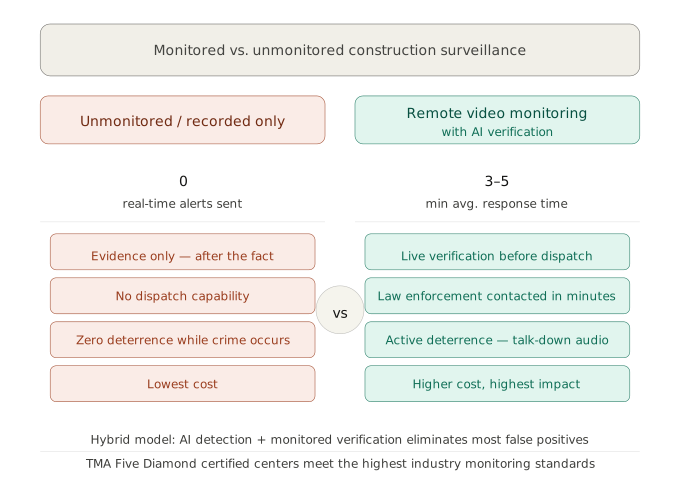
Monitored surveillance means live or near-live camera feeds are actively reviewed by a remote monitoring center or on-site security team, who can dispatch responders when events occur. Unmonitored surveillance records footage for later review but does not generate real-time alerts or dispatch. For most construction sites, monitored surveillance delivers significantly higher theft prevention because it enables a response before criminals leave the site.
Comparison of approaches:
- Unmonitored / recorded only — Lower cost, useful for evidence after the fact, but provides zero deterrence or real-time response capability.
- Motion-triggered alerting — Camera sends push notifications or emails when motion is detected; requires a human to check and respond.
- Remote video monitoring (RVM) — A professional monitoring center receives live or event-triggered feeds, verifies threats visually, and contacts law enforcement or on-site contacts. Average response time is 3–5 minutes.
- On-site security officers — Highest cost, provides a physical deterrence and response layer, but is subject to human fatigue and distraction.
- Hybrid model — The most common approach: AI detection triggers alerts sent to a remote monitoring center that validates before escalating. Eliminates most false positives.
Related industry bodies:
- The Monitoring Association (TMA) — Sets professional standards for remote video monitoring centers, including Five Diamond certification.
- Security Industry Association (SIA) — Publishes standards for video surveillance and access control integration.
How does construction site surveillance integrate with access control?
Construction site surveillance integrates with access control through unified platforms that link camera events to credential reads at gates, turnstiles, and entry points, so every badge swipe, vehicle scan, or biometric check is accompanied by a video timestamp for verification. This pairing closes the gap that standalone cameras leave: a camera can see who enters, but only an integrated access system can enforce who is allowed to enter.
Common access control integrations on construction sites:
- RFID card readers at gates — Workers and visitors tap a card; the system logs entry and links a camera snapshot to the event.
- QR code visitor management — Subcontractors check in via mobile QR code; the system cross-references certifications and site induction status before granting access.
- Biometric time-and-attendance — Fingerprint or facial recognition clocks workers in and simultaneously captures a camera image to prevent buddy-punching.
- Vehicle gate control — LPR cameras read delivery truck plates and automatically open barriers for approved vendors.
- Turnstiles with anti-tailgate sensors — Detect when a second person enters on a single credential and trigger a video alert.
Related platforms and standards:
- OSDP (Open Supervised Device Protocol) — Industry standard for secure communication between access control readers and panels.
- Procore — Construction project management platform with workforce tracking modules that can interface with access control data.
- Autodesk Construction Cloud — Integrates safety and compliance data that surveillance and access logs can populate.
What regulations and legal considerations apply to construction site surveillance?
Construction site surveillance is subject to a mix of federal labor law, state privacy statutes, and local ordinances. The most important requirement in the U.S. is providing clear notice that video surveillance is in use, typically through posted signage at all entry points. Covert surveillance of workers in areas where they have a reasonable expectation of privacy (such as locker rooms or portable toilets) is illegal in all U.S. jurisdictions.
Key legal and compliance considerations:
- Notice and signage — Post clear, visible signs at every entry point stating that video surveillance is active. This is legally required in most U.S. states and is standard practice elsewhere.
- Union agreements — Some collective bargaining agreements restrict where cameras can be placed or how footage can be used for disciplinary purposes. Review all active CBAs before installation.
- State privacy laws — California (CCPA), Illinois (BIPA), and other states have specific regulations around biometric data (facial recognition) and data retention that apply to surveillance systems.
- GDPR (for projects in the EU) — Requires a lawful basis for processing video data, data minimization, and mandatory retention limits.
- Data retention policies — Most construction insurers and legal counsel recommend retaining footage for a minimum of 30–90 days; footage from incident dates should be preserved indefinitely pending litigation.
- Law enforcement requests — Establish a documented policy for responding to subpoenas or law enforcement requests for footage before an incident occurs.
What should a construction site surveillance plan include?
A construction site surveillance plan should include a site risk assessment, a camera placement map, defined coverage zones, connectivity and power infrastructure requirements, a monitoring protocol, and a documented incident response procedure. Without a written plan, camera systems are often installed reactively — covering the wrong areas and missing the moments that matter most.
Core components of a surveillance plan:
- Risk assessment — Identify the highest-value assets, most vulnerable access points, areas with limited natural lighting, and historical loss patterns on similar nearby projects.
- Camera placement map — Overlay camera fields of view on the site plan, ensuring all entry/exit points, equipment laydown areas, material storage, and trailer offices are covered with no blind spots.
- Coverage zones — Classify zones (e.g., perimeter, interior, sensitive equipment) and assign camera specifications and alert rules to each zone.
- Power and connectivity plan — Document power sources (grid, solar, generator) and network connections (wired ethernet, cellular LTE/5G) for each camera position.
- Monitoring schedule — Define whether coverage is 24/7 or limited to after-hours; specify which events trigger alerts and who receives them.
- Incident response protocol — Document the escalation chain when an alert fires: who verifies, who calls law enforcement, who notifies the project owner.
- Maintenance schedule — Cameras on construction sites accumulate dust, mud, and vibration damage. Schedule lens cleaning, connection checks, and firmware updates monthly.
How does construction site surveillance reduce insurance costs?
Construction site surveillance reduces insurance costs by lowering the risk profile of the project in the eyes of insurers. Documented camera coverage — especially with remote monitoring — can qualify a site for reduced premiums on builder’s risk, inland marine, and commercial general liability policies. Surveillance also provides evidentiary footage that can defeat fraudulent injury claims, which are a major driver of construction insurance costs.
Insurance benefits of surveillance deployment:
- Builder’s risk premiums — Some carriers offer 5–20% discounts for sites with verified, centrally monitored camera systems.
- Inland marine coverage — Equipment and tool theft claims are dramatically reduced when surveillance deters and documents theft events.
- General liability claims — Slip-and-fall and workplace injury claims are routinely disputed with surveillance footage; it is one of the most effective tools for reducing fraudulent or exaggerated claims.
- Workers’ compensation — Footage verifying proper safety procedures were followed can reduce the severity rating of a workers’ comp claim.
- Subrogation recovery — When insurers can identify a responsible party from footage, they pursue subrogation and reduce the project’s loss history.
Related industry resources:
- National Equipment Register (NER) — A database that law enforcement uses to recover stolen construction equipment; pairs well with surveillance documentation.
- Insurance Information Institute (III) — Publishes data on construction theft and the risk mitigation value of surveillance.
- Builders Mutual Insurance Company — Example of a carrier with documented loss control programs that credit surveillance investments.
What are the emerging trends in construction site surveillance technology?
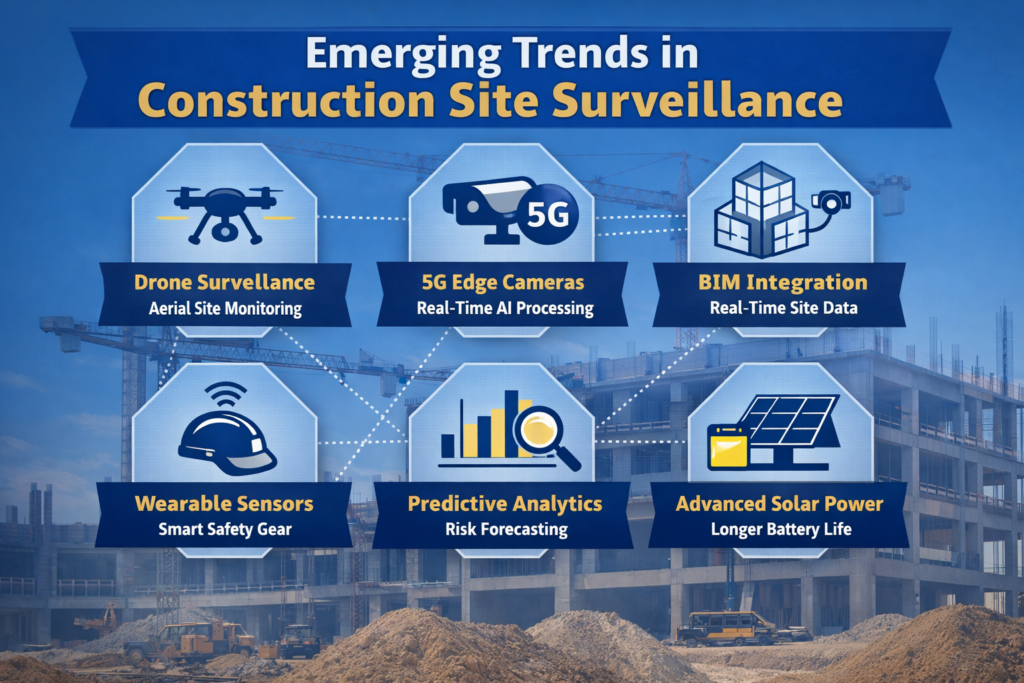
The most significant emerging trends in construction site surveillance are the convergence of AI video analytics with drone-based aerial surveillance, the expansion of 5G-connected edge-computing cameras, and the integration of surveillance data with Building Information Modeling (BIM) platforms for real-time site intelligence. These advances are moving construction surveillance from a reactive security tool to a proactive site management system.
Key trends shaping the next generation of construction site surveillance cameras and systems:
- Drone-as-first-responder (DAFR) — When a perimeter alert fires, an autonomous drone launches, flies to the location, and streams live video to a monitoring center before law enforcement arrives.
- 5G edge cameras — Cameras with onboard AI processing (edge computing) connected via 5G eliminate latency and reduce bandwidth costs by only uploading flagged events rather than continuous streams.
- BIM integration — Camera feeds and sensor data are mapped into the site’s 3D BIM model, allowing project managers to visualize real-time activity against the construction schedule.
- Wearable integration — Smart helmets and vests with embedded sensors communicate with site cameras to track worker location, detect falls, and monitor biometrics like heat stress.
- Predictive analytics — AI platforms analyze historical incident patterns by time, day, weather, and site phase to predict and pre-position surveillance resources before high-risk periods.
- Solar + battery advancements — Next-generation lithium iron phosphate (LiFePO4) battery packs extend off-grid camera uptime to 14+ days without sunlight, making surveillance viable in northern climates and covered areas.
Related organizations advancing construction tech:
- Construction Industry Institute (CII) — Conducts research on technology adoption, including surveillance and site automation, in the construction sector.
- buildingSMART International — Develops open BIM standards that surveillance data integration is increasingly aligned with.
- FAA (Federal Aviation Administration) — Governs drone operations on and around construction sites in the U.S., including BVLOS (beyond visual line of sight) authorization for DAFR programs.
Conclusion
Construction site surveillance has evolved from simple cameras into a critical, multi-layered system for protecting people, equipment, and project timelines. By combining AI-powered analytics, remote monitoring, and flexible deployment options like solar and trailer-mounted construction site surveillance cameras, today’s solutions do far more than record footage — they actively prevent loss, improve safety compliance, and reduce liability.
For project managers and owners, the value is clear: fewer theft incidents, stronger documentation, and greater control over what’s happening on site at any given moment. As construction projects become more complex and risk exposure continues to rise, investing in construction site surveillance is no longer optional — it’s a foundational part of running a secure, efficient, and well-managed jobsite.
Platforms like TrueLook bring all of these capabilities together—combining live viewing, AI-powered alerts, time-lapse, and professional monitoring into one streamlined construction site surveillance solution. Learn more about TrueLook’s surveillance solutions.