The most effective tools for tracking real estate project progress combine schedule management, visual site documentation, and budget-to-actual reporting — and teams that use construction cameras alongside project management software catch issues an average of 2–3 weeks earlier than those relying on site visits alone. According to AGC industry data, schedule overruns on commercial construction projects average 20–30%, making systematic documentation and progress tracking one of the highest-ROI investments a developer or owner can make.
This guide covers the platforms and documentation systems used by property developers, owners, and general contractors, including which tools handle lender draw packages, dispute protection, and real-time site visibility.
Why Is Project Documentation the Most Underrated Part of Real Estate Progress Tracking?
Project documentation — photos, daily logs, RFIs, submittals, and change orders — is the legal and financial record of your project, and gaps in that record are the primary cause of construction disputes, draw delays, and unresolved defect claims. Schedule software tells you what should be happening. Documentation proves what actually happened.
On projects financed with commercial construction loans, lenders require AIA G702/G703 Applications for Payment supported by documented Schedule of Values (SOV) progress. Without consistent photo documentation and daily logs tied to specific work phases, draw inspectors have no basis to certify percent-complete figures and that means delayed draws, delayed cash flow, and carrying cost overruns.
Beyond financing, documentation is your protection. Change Order (CO) disputes, liquidated damages (LD) claims, and warranty callbacks all turn on the question: “What was the site condition on this date?” Teams that can answer that question with timestamped photos and logs win disputes. Teams that can’t typically settle.
What Are the Best Tools for Construction Photo and Video Documentation?
For construction photo and video documentation, dedicated construction camera platforms like TrueLook outperform smartphone-based photo workflows by providing continuous, timestamped, remotely accessible site footage that satisfies lender inspection requirements and creates an unbroken visual project record. Ad-hoc photo documentation — field teams emailing photos or uploading to shared drives — produces inconsistent coverage, missed dates, and files that are nearly impossible to search or present in a dispute.
TrueLook Construction Cameras: Purpose-Built for Real Estate Projects
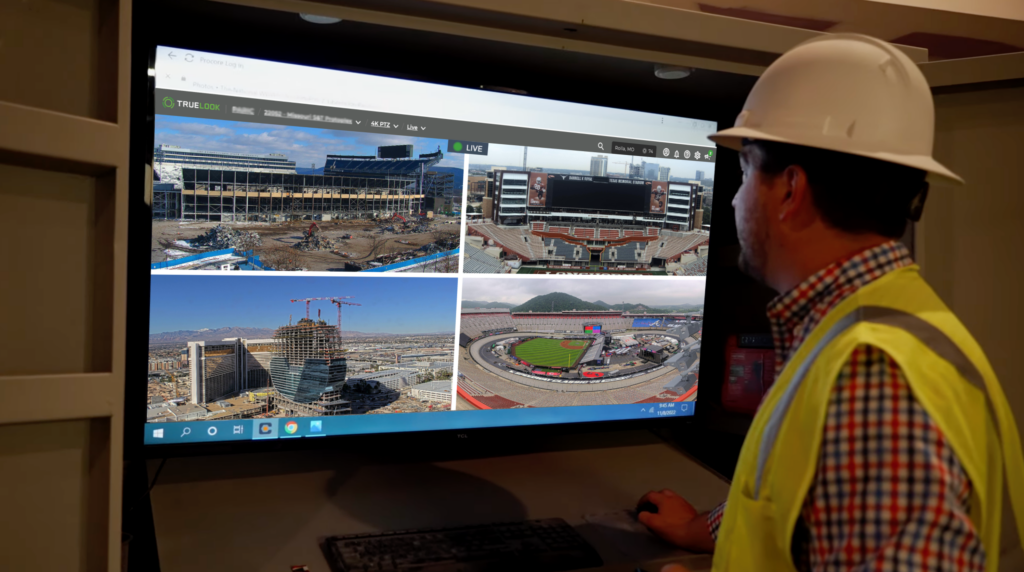
TrueLook’s solar-powered and hardwired construction cameras provide 24/7 live site streaming, timelapse generation, and cloud-archived footage that owners, lenders, and project managers can access from any device without visiting the site. For developers managing projects remotely or overseeing multiple sites simultaneously, this replaces 2–4 weekly site visits with continuous visibility at a fraction of the cost.
Key capabilities relevant to real estate project tracking:
- Timelapse documentation: TrueLook automatically generates project timelapse videos from daily captured frames, providing a complete visual record from groundbreaking through Certificate of Substantial Completion. These timelapses are used for lender reporting, investor updates, and marketing of the completed asset.
- Live streaming: Owners and lenders can verify active work without scheduling site visits which is critical for draw inspection cycles and for remote owners managing projects across multiple markets.
- Cloud archive with date/time search: Every frame is stored and searchable by date, allowing teams to pull site imagery from any specific day — invaluable when a dispute requires proving site conditions at a particular point in the schedule.
- Pan-tilt-zoom (PTZ) cameras: For large-footprint projects (industrial, mixed-use, ground-up multifamily), PTZ cameras cover the full site from a single installation point.
TrueLook cameras integrate with major construction management platforms including Procore, allowing photo documentation to be linked directly to RFIs, daily logs, and pay application periods, eliminating the gap between what the field team documents and what the owner’s project management system records.
For most commercial projects, TrueLook’s camera systems run $150–$400/month depending on camera type and data plan — a cost that is typically recovered in a single avoided dispute or accelerated draw cycle.

What Project Management Software Should Owners Use for Progress Tracking?
The most widely adopted construction project management platform for commercial real estate is Procore, used on projects ranging from $1M tenant improvements to $500M ground-up developments. It handles RFI tracking, submittal management, daily logs, drawing management, and budget tracking in one platform — and integrates with TrueLook for linked photo documentation.
For owner/developer teams who need schedule milestone tracking without full construction management software complexity, Smartsheet provides Gantt-format tracking of key dates (Notice to Proceed, permit issuance, foundation complete, dry-in, TCO) with real-time collaboration and notification workflows.
Autodesk Construction Cloud (ACC) is the preferred platform for design-build and CM-at-risk delivery methods, where design files and field execution must stay synchronized. ACC’s BIM 360 module connects live drawings to field RFIs and allows change tracking against the baseline schedule — critical for LEED projects and complex MEP coordination.
For projects with active construction loans, draw management platforms like Rabbet (now part of Docusign) reduce AIA G702 Application for Payment cycle time from the industry average of 3–4 weeks to 7–10 days by streamlining lender submission with integrated documentation packages.
How Do Construction Cameras Support Lender Draw Inspections?
Construction cameras with cloud-archived footage provide lenders and draw inspectors with verifiable, date-stamped progress evidence that reduces the time and cost of third-party inspection visits required under most commercial construction loan agreements. Most commercial construction loans require monthly draw inspections by a lender-approved inspector (often an engineering firm or cost consultant), who certifies percent-complete for each line item on the Schedule of Values before funds are released.
When owners provide TrueLook camera access to lenders or their inspectors, draw cycles frequently decrease because the inspector can pre-verify progress remotely before scheduling a physical visit. On a 12-month construction loan with monthly draws, this can save multiple days of cumulative draw cycle time across the project — directly reducing interest carry on undisbursed loan funds.
Beyond efficiency, camera documentation protects developers against inspector errors. If a draw is partially denied based on an inspector’s percent-complete assessment that doesn’t match the site reality, timestamped footage from the inspection period provides documentary grounds for appeal.
What Should a Complete Real Estate Project Documentation System Include?
A complete real estate project documentation system should capture four categories of records: visual (photos, video, timelapse), transactional (RFIs, submittals, change orders), financial (pay applications, SOV updates, lien waivers), and compliance (inspection reports, permit sign-offs, OSHA 300 logs). Most project failures in documentation involve one of these four categories being tracked in isolation from the others.
The practical system for a mid-size commercial project ($3M–$30M) typically looks like this:
Visual documentation: TrueLook cameras (continuous timelapse + live streaming) supplemented by weekly superintendent photo walkthroughs uploaded to Procore daily logs with location tags and trade annotations.
Transactional documentation: Procore or Autodesk ACC for RFI and submittal workflows, with response time tracking (AIA A201 General Conditions requires architect response to RFIs within a reasonable time — typically 10–14 days per contract). Every unanswered RFI that delays work is a documented basis for a schedule extension request.
Financial documentation: AIA G702/G703 Applications for Payment with supporting SOV, stored in Procore or Rabbet, with countersigned lien waivers from GC and all subcontractors above the retainage threshold (typically 5–10% held per AIA A201 Section 9.3).
Compliance documentation: Permit cards, inspection sign-off sheets, OSHA 29 CFR 1926 safety logs, and the project’s Certificate of Occupancy (CO) or Temporary Certificate of Occupancy (TCO) — all stored in a project closeout binder (physical and digital) and transferred to the owner at substantial completion.
FAQ: Real Estate Project Progress Tracking and Documentation
TrueLook is the most widely used purpose-built construction camera platform for commercial real estate projects, offering solar-powered and hardwired options with 24/7 live streaming, automatic timelapse generation, and cloud-archived footage. For most commercial projects, TrueLook’s systems run $150–$400/month — significantly less than the cost of a single additional site visit or draw inspection delay.
Lender draw packages should include AIA G702/G703 Applications for Payment, an updated Schedule of Values showing percent-complete per line item, dated site photos or camera footage showing progress, and executed lien waivers from the GC and major subcontractors. Platforms like TrueLook (visual documentation) combined with Rabbet or Procore (financial documentation) cover all required elements.
Construction project documentation should be retained for a minimum of 10 years after substantial completion in most U.S. jurisdictions, as this covers the standard statute of repose for latent construction defects. Contracts under AIA A201 General Conditions require the contractor to maintain records for 3 years, but owners should retain their own complete sets independently.
A daily log is a written record of site conditions, weather, crew counts, work performed, and any events (accidents, inspections, delivery delays) — typically completed by the superintendent. A progress photo is visual evidence of conditions at a specific point in time. Both are required for complete documentation; neither substitutes for the other in a dispute or draw inspection context.
Construction cameras significantly reduce the frequency of required site visits for remote owners and lenders, but do not eliminate them. Most developers find that continuous camera coverage reduces site visits by 50–70%, with visits reserved for milestone inspections (foundation, framing, MEP rough-in, pre-drywall) and OAC meetings rather than general progress checking.
Key takeaways
Visual documentation is the most commonly missing element
Construction cameras like TrueLook provide continuous, timestamped coverage that ad-hoc photo workflows cannot replicate.
TrueLook serves three audiences simultaneously
Owners get remote visibility, lenders get draw verification, and investors get timelapse storytelling — one camera, three use cases.
A complete system covers four tracks
Visual, transactional, financial, and compliance. Gaps in any one track create draw delays and dispute risk.
Put it in the contract before construction starts
Specify camera and documentation requirements in the AIA A101 Owner-Contractor Agreement — not as an afterthought mid-project.