Before a single server rack goes into a data center, the power infrastructure to feed it has to exist. That means a dedicated substation, high-voltage transformers, switchgear, and often miles of underground or overhead distribution, all engineered and built before the building itself is more than a slab. If you’re planning a data center project, the power build isn’t a line item. It’s the critical path.
That’s the part of this industry that trips up teams who are used to a normal commercial build sequence. Data center power infrastructure doesn’t follow the building. It leads it.
What Counts as Data Center Power Infrastructure
When people say “data center power infrastructure,” they usually mean the full chain that gets utility-scale electricity down to a rack-ready voltage. That includes:
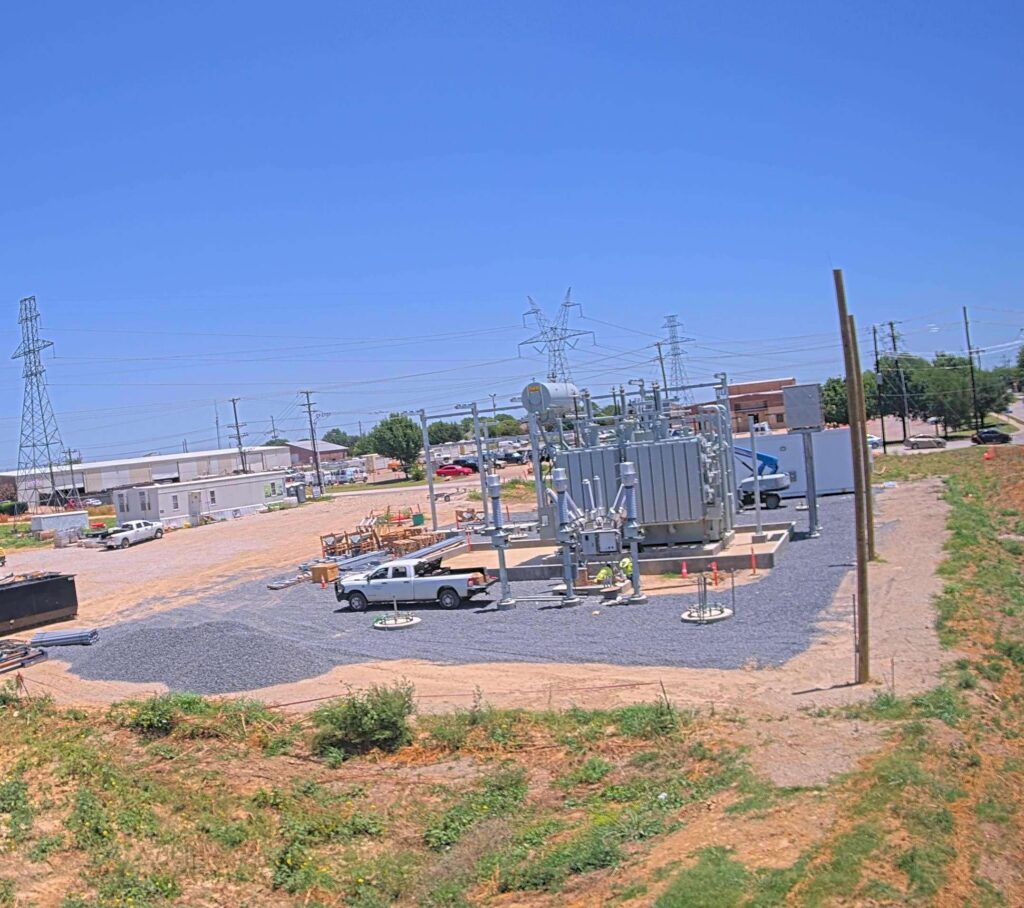
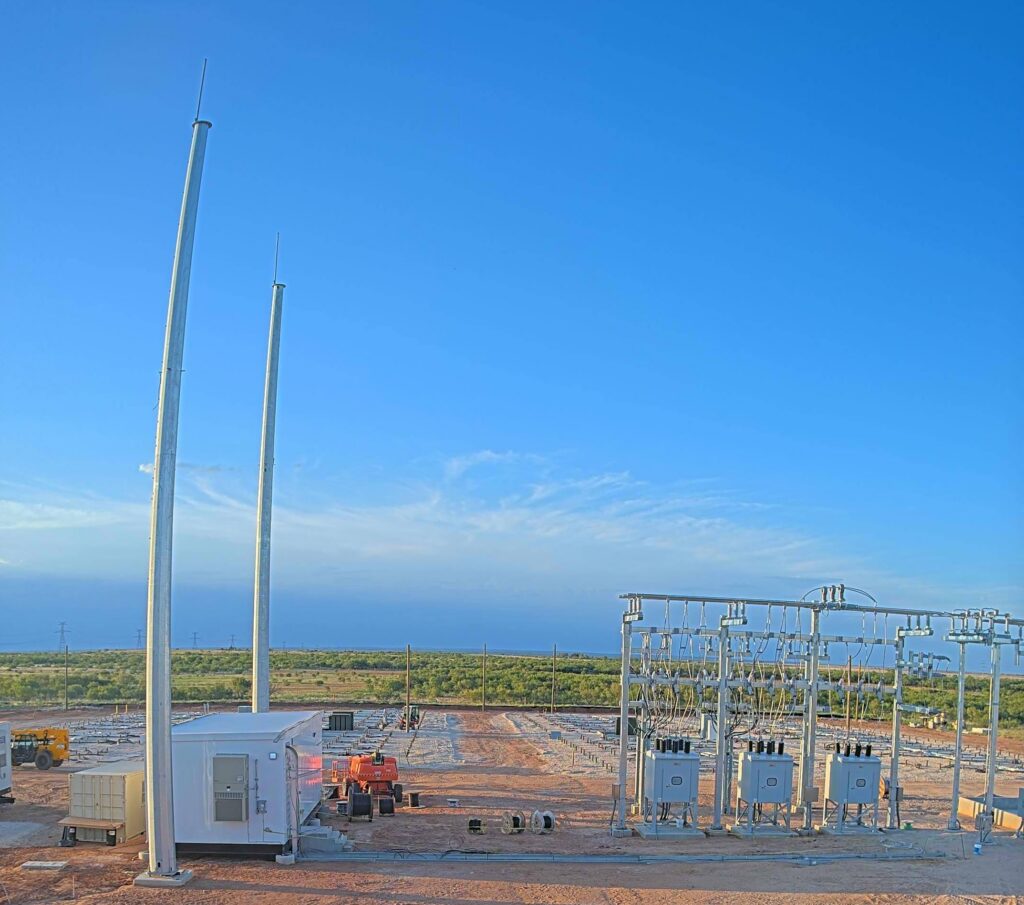
- A dedicated substation stepping utility transmission voltage down to a usable distribution voltage
- Power transformers, often multiple units for redundancy, sized for the facility’s full load plus growth
- Switchgear to route, protect, and isolate circuits
- Backup generation (diesel or gas turbine) and the fuel systems to support it
- UPS systems for the gap between a utility outage and generator startup
- Distribution to the building, whether underground duct bank or overhead lines
Each of those is its own construction scope, with its own permitting, its own long-lead equipment, and its own inspection requirements. On a hyperscale or AI-driven campus, several of these run in parallel across different contractors.
Why the Substation Comes First
A single data center campus can pull tens of megawatts, and AI-driven campuses are pushing well past that. That load doesn’t run on a standard commercial service. It needs a purpose-built substation, and that substation needs utility approval, an interconnection study, and equipment that’s often ordered a year or more before it’s needed.
Utility transformers, especially the large power transformers used at this scale, have become one of the longest lead-time items in construction right now. Engineering News-Record has tracked this bottleneck across the broader grid buildout, and it applies just as directly to data center projects: the substation and its transformers frequently determine the entire project schedule, not the building shell.
That’s why “build data center infrastructure” and “build the data center” aren’t the same project anymore. The power infrastructure is commonly awarded, permitted, and under construction before the general contractor has broken ground on the building.
Why AI Changed the Timeline
Traditional data centers were built to a known, relatively stable power density. AI training and inference hardware changed that. Rack densities have climbed, cooling loads have climbed with them, and the electrical infrastructure has to be sized for peak draw, not average draw.
Construction Dive has covered how this shift is reshaping data center construction pipelines, with utilities and developers now negotiating power delivery timelines years in advance of a facility’s planned opening. If you’re scoping a data center power infrastructure project today, plan on the electrical work setting the schedule for the entire campus, not following it.
The Build Sequence: What Actually Happens First
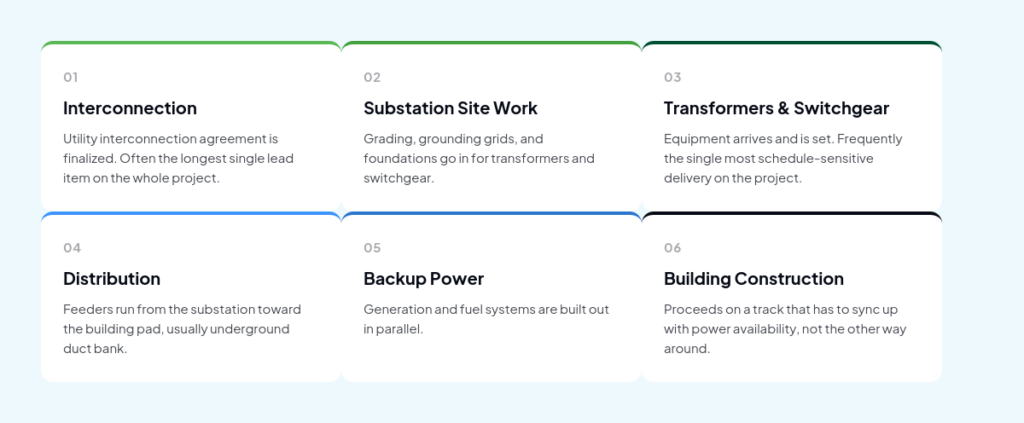
On most data center campuses, the sequence looks something like this:
- Utility interconnection agreement is finalized, often the longest single lead item on the whole project
- Substation site work begins, including grading, grounding grids, and foundations for transformers and switchgear
- Transformers and switchgear arrive and are set, frequently the single most schedule-sensitive delivery on the project
- Distribution feeders are installed from the substation toward the building pad, usually underground duct bank
- Backup generation and fuel systems are built out in parallel
- Building construction proceeds on a track that has to sync up with power availability, not the other way around
Any slip in steps one through three cascades through everything after it. That’s the part owners and GCs feel the most, because it’s largely out of the general contractor’s direct control.
Common Bottlenecks in Data Center Power Infrastructure Projects
A few things consistently slow these projects down:
- Transformer lead times: Large power transformers can run well over a year from order to delivery, and that clock starts the moment the interconnection agreement is signed, not when construction crews mobilize.
- Utility interconnection queues: In high-demand regions, getting a signed agreement and a study completed takes longer than the actual construction.
- Multiple contractors on one site: Substation work, distribution, generator installation, and building construction often run under separate contracts with separate schedules that all have to line up at the same handoff points.
- Commissioning coordination: Power has to be live, tested, and stable before IT equipment installation can start, which means the electrical scope has its own commissioning milestone ahead of the building’s.
Keeping Oversight Across a Multi-Contractor Power Build
The practical challenge on these sites isn’t usually the engineering. It’s visibility. When substation work, underground distribution, generator pads, and the building shell are all moving at once, often under different contractors, an owner’s rep or GC needs a way to see progress across all of it without driving between sites or waiting on weekly photo updates.
That’s the same problem TrueLook’s live jobsite camera and time-lapse system is built to solve on complex, multi-phase builds. Rather than relying on a single site visit to catch a transformer delivery or confirm duct bank backfill before it’s covered, you can pull up any active site from a phone and see exactly where things stand. On a campus with several concurrent scopes, that kind of remote oversight across multiple job sites is often the difference between catching a schedule slip early and finding out about it at the next status meeting.
For long-duration power infrastructure builds specifically, a running time-lapse record of the substation buildout also gives owners a clean, dated record of exactly when each milestone, foundation pour, transformer set, energization, actually happened. That matters for utility documentation and for resolving any schedule disputes later.
Built for Data Center Power Builds, Not Just Buildings
TrueLook covers every contractor working the site, substation, distribution, generator pads, and the building shell, from one dashboard. See exactly where the power build stands before you’re on-site.
FAQ
It’s the full chain of electrical systems that deliver utility power to a data center at usable voltage. That includes a dedicated substation, power transformers, switchgear, backup generation, UPS systems, and distribution to the building.
Because the substation and its transformers have the longest lead times and the most complex permitting on the entire project. Building construction is scheduled around power availability, not the reverse.
It varies by utility and region, but the interconnection agreement and transformer procurement alone commonly take a year or more before construction even starts on-site.
Demand for large power transformers has outpaced manufacturing capacity across the grid, driven partly by data center growth and partly by broader utility infrastructure upgrades. It’s a documented, industry-wide bottleneck, not specific to any one project.
Seeing the Whole Build, Not Just the Building
If you’re managing a data center power infrastructure project with multiple contractors and a schedule that depends on catching problems early, it’s worth looking at how [live jobsite video](INTERNAL LINK NEEDED: solutions/AI-monitoring page) can give you eyes on the substation, the duct bank, and the building shell without adding another site visit to your week.