Quick Answer
- Demolition monitoring solutions combine cameras, time-lapse documentation, and live streaming to give project teams real-time visibility into demolition progress
- Effective monitoring reduces liability exposure, protects against disputes, and creates a verified record of every phase of the teardown
- Camera-based systems are the most cost-effective solution for remote monitoring across large demolition footprints
- TrueLook’s jobsite cameras are used by demolition contractors and project owners to document activity, deter unauthorized access, and capture time-lapse records of the full teardown sequence
Demolition monitoring solutions are tools and systems, primarily camera-based, that allow contractors, owners, and project managers to observe, document, and verify demolition activity in real time and on record. The best solutions combine live streaming, cloud-stored footage, and time-lapse photography to create an unbroken visual record from the first swing of the excavator to site clearance.
Why Demolition Projects Require Dedicated Monitoring
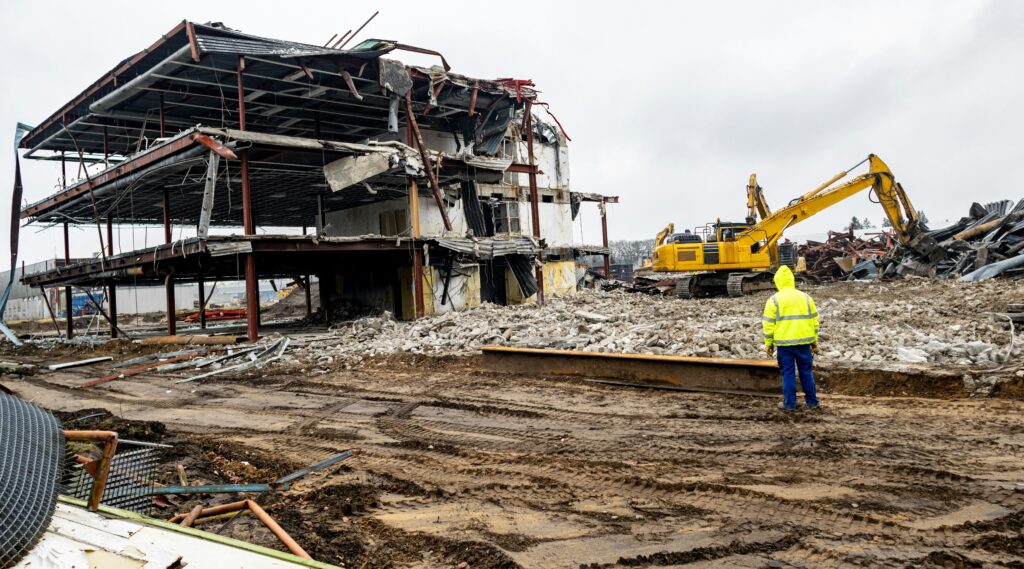
Demolition is one of the highest-liability phases of any construction project. Unlike new construction, where work is additive and documented incrementally, demolition removes structures, and once something is gone, there’s no rebuilding the record of how it came down. Disputes over what existed, what was salvaged, what was damaged on adjacent properties, and whether hazardous materials were handled properly are among the most common sources of legal exposure in the demolition industry.
According to construction risk management data, demolition and site preparation work carries a disproportionate share of third-party property damage claims, with neighboring property disputes representing the most frequently litigated category. A verified, timestamped video record is the single most effective tool for defending against these claims or for proving that a subcontractor deviated from the agreed demolition plan.
As we move throughout 2026, the industry has shifted from ‘nice-to-have’ tech to ‘non-negotiable’ integrated systems. According to recent Autodesk industry insights, project owners now expect a level of digital transparency that only 24/7 site capture can provide. This aligns with the broader 2025-2026 Construction Safety Challenges, which emphasize that remote monitoring is now a primary strategy for managing jobsite risk amidst labor shortages.
Beyond liability, demolition monitoring gives project owners and general contractors the ability to verify progress remotely. A 10-story building coming down on a tight urban site, a historical structure with selective demolition requirements, or a multi-phase industrial teardown all benefit from continuous visual coverage that no site visit schedule can replicate.
What Do Demolition Monitoring Solutions Include?
A complete demolition monitoring solution typically includes four components:
- Live video streaming — Cameras that stream continuously to a web portal or mobile app, allowing authorized team members to check site activity from anywhere at any time
- Motion-activated recording — Footage triggered by movement, capturing activity during off-hours when unauthorized access, equipment theft, or vandalism is most likely
- Time-lapse photography — Automated interval photography that compresses weeks of demolition into minutes of footage, creating a shareable record of the project sequence
- Cloud storage with searchable archives — Footage stored off-site with at least 30 days of rolling retention, accessible by date and time for investigation or documentation purposes
The most effective systems integrate all four into a single platform, eliminating the need to manage separate tools for security and documentation.
How TrueLook Supports Demolition Monitoring
TrueLook’s construction cameras are deployed on demolition sites by contractors and owners who need the full picture — before, during, and after teardown. TrueLook cameras are weather-resistant, built for temporary power setups, and available in solar-powered configurations that allow placement anywhere on a demolition footprint without trenching for power.
The time-lapse feature is particularly valuable for demolition projects. Automated daily captures compress the entire teardown sequence into a professional-grade time-lapse that project owners can use for stakeholder reporting, marketing, and regulatory documentation.
This documentation is critical for compliance with OSHA Demolition Safety Guidelines. For example, OSHA Standard 1926.850(a) requires a written engineering survey to be performed before any demolition begins. By using high-resolution imagery to document the state of the structure before and during the initial phases, contractors create a visual audit trail that proves the demolition plan was followed according to the required engineering survey.
For selective demolition projects, where specific structural elements must be preserved, the visual record also serves as proof of compliance.
TrueLook’s PTZ (pan-tilt-zoom) cameras allow a single unit to cover a large demolition area, panning across the site to capture multiple zones from one mounting point. For teams monitoring from off-site, TrueLook’s mobile app provides live feeds and motion alert notifications, so you know the moment something happens on site without needing someone physically present.
How Demolition Camera Placement Affects Coverage
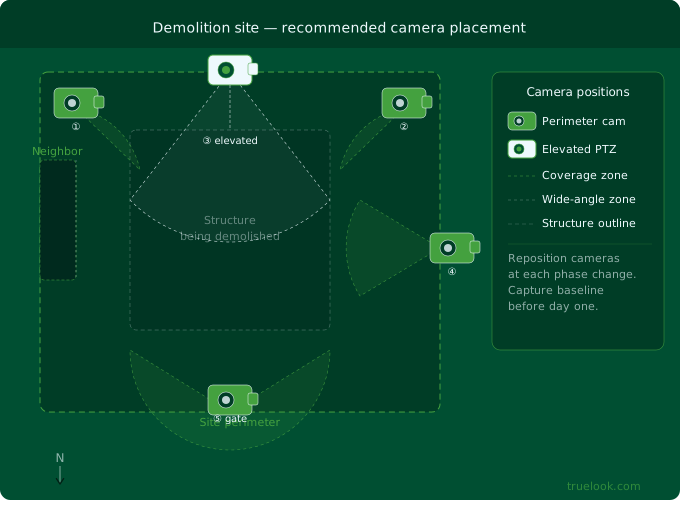
Camera placement on a demolition site is more complex than on a standard construction project, because the site changes dramatically week to week. Structures that blocked sightlines in week one may be gone by week three, opening new angles, or creating new blind spots.
Best practices for demolition camera placement include:
- Perimeter coverage first — Position at least one camera to cover each access point to the site. Unauthorized entry before, during, and after active demolition hours is a primary risk.
- Adjacent property sightlines — Mount at least one camera with a clear view of the boundary between the demolition site and neighboring structures. This is your primary defense against third-party damage claims.
- Elevation advantage — Cameras mounted at height, on temporary structures, lift equipment, or adjacent buildings, capture the full scope of demolition activity better than ground-level units.
- Relocate as the project progresses — Plan for camera repositioning at major milestones. What covers the site in week one may be obsolete once a building section is removed.
- Document before work begins — The most important footage is often the pre-demolition baseline. Capture the full site condition, including adjacent properties, before the first piece of equipment arrives.
Key Considerations When Choosing a Demolition Monitoring System
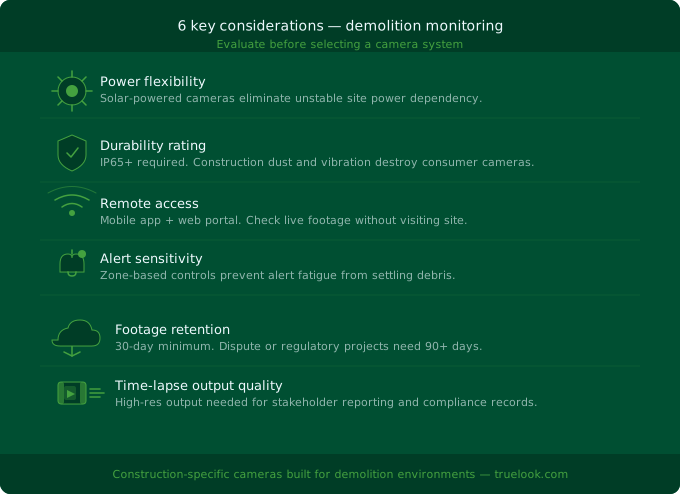
- Power flexibility — Active demolition sites often don’t have stable grid power. Solar-powered cameras eliminate the dependency on temporary power hookups.
- Durability — Dust, vibration, and debris are constant on demolition sites. Look for cameras rated IP65 or higher for outdoor use in harsh conditions.
- Remote access — Your team shouldn’t need to be on-site to check footage. Prioritize systems with mobile apps and web portals.
- Alert sensitivity — Motion alerts need to be configurable. A high-sensitivity setting that fires every time debris settles is not useful. Look for systems that allow zone-based or time-windowed alert rules.
- Footage retention — For demolition documentation and legal protection, 30 days of rolling retention is a minimum. Projects with active disputes or regulatory scrutiny may need 90 days or more.
- Time-lapse output quality — If you’re using time-lapse for stakeholder reporting or marketing, confirm the system produces high-resolution output rather than compressed low-quality files.
Frequently Asked Questions
The best demolition monitoring camera is one that combines live streaming, motion-activated recording, time-lapse photography, and cloud storage in a single system — with solar power capability for sites without stable grid access. TrueLook’s jobsite cameras meet all of these criteria and are purpose-built for the construction and demolition environment, unlike consumer-grade security cameras that typically fail under the dust and vibration conditions of an active demolition site.
Time-lapse compresses the entire demolition sequence into a condensed video record, creating visual proof of how the project progressed phase by phase. This is valuable for regulatory compliance on projects with selective demolition requirements, for owner reporting, and for defending against claims that work was done out of sequence or that specific structures were improperly handled.
Yes — and this is one of the primary reasons demolition contractors and project owners invest in camera systems. A timestamped, cloud-stored video record creates verifiable evidence of site conditions at any point in the project. When a neighboring property owner claims their building was damaged during demolition, camera footage showing the exact sequence of events — including the pre-demolition baseline condition of adjacent structures — is the most direct form of defense available.
The number depends on site size, but most mid-size demolition projects (a single commercial building or a city block) are adequately covered by 2–4 cameras. The priority is perimeter access coverage, adjacent property sightlines, and at least one elevated angle capturing the full scope of demolition activity. For large industrial demolition sites, 6–8 cameras may be appropriate.
Construction-specific cameras built for demolition environments, like those from TrueLook, are rated for dust, moisture, and outdoor exposure (IP65+). Standard consumer cameras are not rated for this environment and frequently fail within weeks on an active demolition site.
Conclusion
Demolition monitoring is not optional on high-risk projects, it’s a liability management tool, a documentation asset, and a remote oversight capability rolled into one. The right system gives you a verified visual record from pre-demolition baseline through final site clearance, covering every phase your team may need to reference months or years later.
TrueLook’s jobsite cameras are used across demolition projects of all sizes to deliver exactly this: live streaming, time-lapse documentation, motion-alert security, and cloud-stored archives — in a system designed for the harsh, fast-changing conditions of an active demolition site. Visit truelook.com to see how demolition teams are using jobsite cameras to protect their projects.