Here’s an uncomfortable truth about jobsite cameras: most failures have nothing to do with image quality. They fail because of water intrusion, dead batteries, or a housing that couldn’t survive a summer on a rooftop.
If you’re documenting a 12- or 24-month build, your camera has to survive every storm, heat wave, and freeze between groundbreaking and ribbon-cutting, without anyone climbing a pole to babysit it.
That’s why choosing an outdoor timelapse camera comes down to three things: weatherproofing, power, and durability. In this guide, you’ll learn:
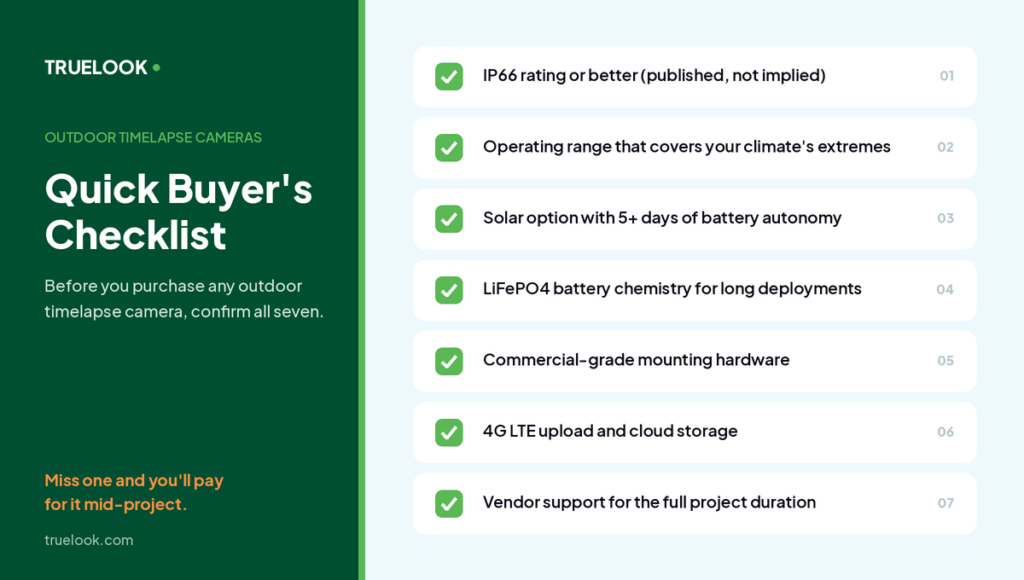
- How to read IP ratings (and the minimum you should accept)
- What a solar time lapse camera setup actually needs to run off-grid
- The durability specs that separate professional systems from consumer gear
Why Weatherproofing Comes First
An outdoor camera lives in the worst spot on your site: fully exposed, high up, and untouched for months. Before comparing megapixels, check how the camera is sealed.
Understanding IP Ratings
Every serious waterproof time lapse camera carries an Ingress Protection (IP) rating: two digits that tell you how well the housing resists solids and liquids. The first digit covers dust (0–6), the second covers water (0–9).
For construction and long-term outdoor use, two ratings matter:
| Rating | Dust | Water | Good enough for jobsites? |
|---|---|---|---|
| IP65 | Dust-tight | Low-pressure jets | Marginal (light-duty only) |
| IP66 | Dust-tight | Powerful jets from any direction | ✅ Minimum standard |
| IP67 | Dust-tight | Temporary submersion (1m, 30 min) | ✅ Best for flood-prone sites |
Bottom line: Treat IP66 as your floor. It’s engineered to handle wind-driven rain in a thunderstorm, which is exactly what a pole-mounted camera faces. IP67 adds submersion protection, which matters if your site is prone to flash flooding, but for most installations IP66 is sufficient.
Here’s what most buyers get wrong: a “weatherproof” marketing label without a published IP rating means nothing. It’s a red flag TrueLook’s operations team sees constantly when customers replace failed consumer hardware. If the spec sheet doesn’t state the rating, assume the worst.
Beyond the IP Rating
Water isn’t the only threat. Also check:
- Operating temperature range – Consumer cameras often top out at a range of roughly 32°F–104°F. Professional outdoor units typically run from -4°F to 122°F or wider, with industrial models rated down to -20°F. If you build through Midwest winters or Arizona summers, this spec is non-negotiable.
- Condensation control – Temperature swings pull moisture inside housings. Look for sealed enclosures with desiccant or breathable membrane vents.
- Sun load – A dark housing in direct sun can run 30°F+ above ambient. Sun shields and light-colored enclosures extend sensor life.
Solar Power: Cutting the Cord (Done Right)
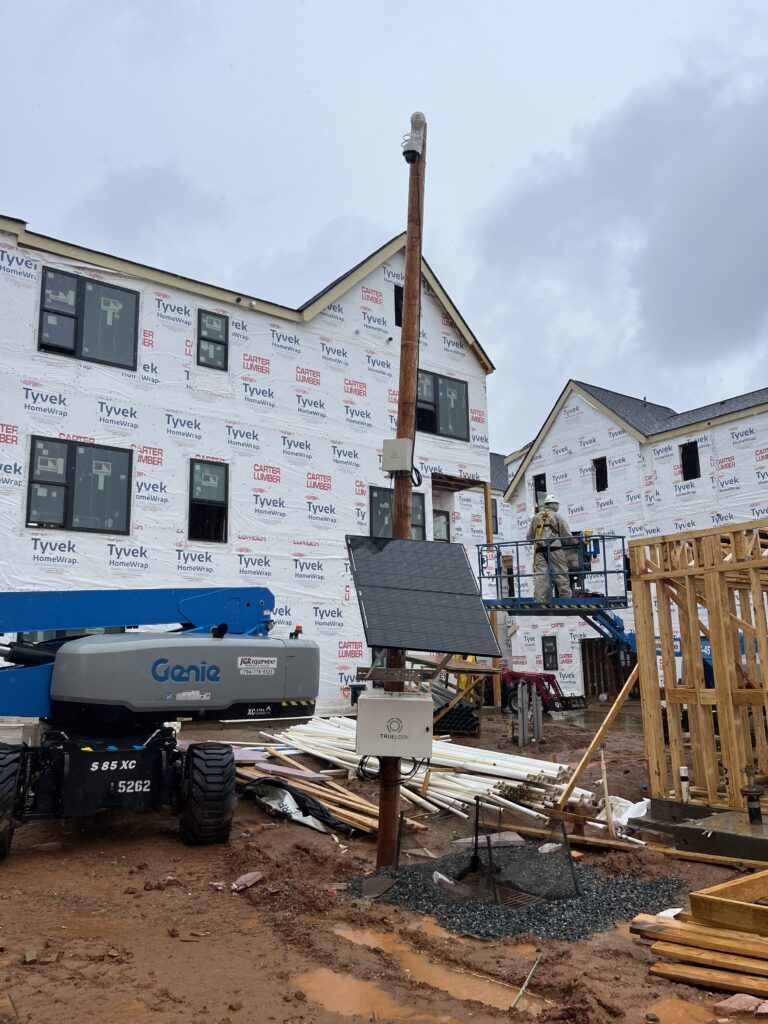
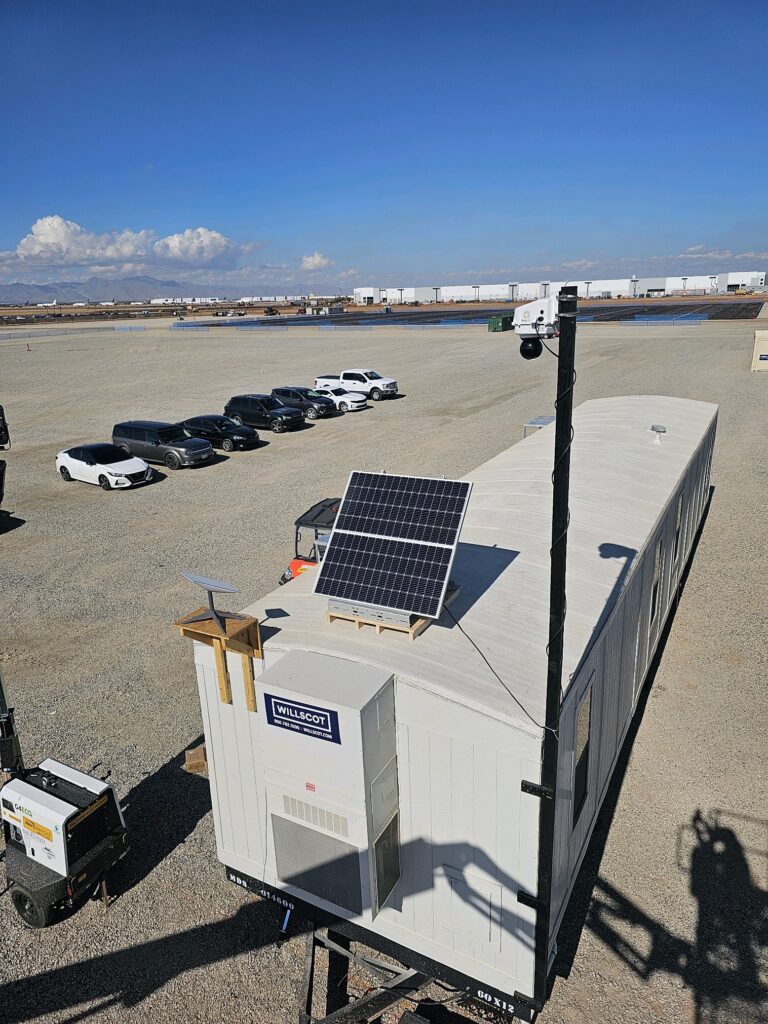
Most construction sites don’t have reliable power where you want the camera and running conduit to a pole is expensive. That’s why a solar time lapse camera is the default choice for professional deployments.
What a Solar Setup Actually Needs
A solar system is only as good as its worst week of weather. Three specs determine whether it survives:
- Panel wattage. Professional systems typically pair the camera with an 80W+ panel. Ultra-low-power time-lapse units can run on as little as 20W, but anything streaming live video or capturing frequent intervals needs more.
- Battery capacity and chemistry. Look for lithium iron phosphate (LiFePO4) batteries. They handle roughly 4x more charge cycles than standard lithium-ion and tolerate temperature swings far better.
- Battery autonomy. This is the big one: how many days can the camera run with zero sun? Quality systems deliver 5–7+ days of autonomy. If a vendor can’t answer this question, keep shopping.
Pro tip: Cold weather cuts battery performance significantly. If you’re deploying in northern climates, size the battery bank for winter, not summer. The season with the least sun is also the season that drains batteries fastest.
Solar Placement Matters
Even a great system fails if the panel faces the wrong way. Orient panels south (in the Northern Hemisphere), keep them above dust-spray height, and plan to wipe them down during site visits. Across the deployments TrueLook’s operations team manages, a dusty panel on an active earthwork site can lose a meaningful share of its output in just a few weeks.
Durability: Built for 18 Months, Not 18 Days
Weather sealing and solar keep the camera alive. Durability keeps it useful for the entire project.
The Biggest Durability Mistakes (And How to Avoid Them)
Mistake #1: Buying consumer gear for a commercial timeline. Action cameras and trail cams are designed for days or weeks of intermittent use, not a year-plus of continuous outdoor duty. ✅ Fix: Choose purpose-built construction cameras with commercial-grade housings and vendor support.
Mistake #2: Ignoring mounting hardware. The camera survives the storm; the flimsy bracket doesn’t. Vibration from wind slowly shifts your framing, ruining the final time-lapse. ✅ Fix: Look for rigid pole or wall mounts rated for wind load, and verify the camera holds position over time.
Mistake #3: Underestimating the project timeline. Commercial construction schedules slip. A camera specced for a 14-month build often needs to run 20. Warranty coverage and vendor support that end mid-project leave documentation gaps that can’t be recovered. ✅ Fix: Confirm support and hosting terms extend beyond your baseline schedule.
Mistake #4: Forgetting about theft and vandalism. Construction theft is a billion-dollar problem. The National Insurance Crime Bureau estimates equipment theft alone costs the U.S. industry up to $1 billion annually, with only about 20% of stolen equipment ever recovered. Your camera is both a target and a deterrent. ✅ Fix: Mount high, use tamper-resistant hardware, and choose a system with security monitoring so the camera pays for itself in loss prevention.
Connectivity and Data Protection
A durable camera protects your footage, not just its housing. Prioritize:
- 4G LTE connectivity so images upload off-site immediately (a stolen camera shouldn’t mean stolen footage)
- Cloud backup with automatic upload, so no one has to swap SD cards
- Remote health monitoring that alerts you when battery, signal, or lens condition degrades
Frequently Asked Questions About Outdoor Time-Lapse Cameras
What is the best IP rating for an outdoor time-lapse camera?
IP66 is the minimum for long-term outdoor use: it’s fully dust-tight and withstands powerful water jets from any direction. Choose IP67 if the camera could face temporary submersion, such as flood-prone sites.
Can a solar time lapse camera run all winter?
Yes, if it’s sized correctly. Look for systems with 5–7+ days of battery autonomy and LiFePO4 batteries, which tolerate cold far better than standard lithium-ion. In low-sun northern climates, oversize the panel and battery bank for winter conditions.
How long can an outdoor timelapse camera record?
Professional construction time-lapse systems are designed to run continuously for the full project, commonly 12 to 36 months, with solar power and cloud upload eliminating the need for battery swaps or SD card retrieval.
Are waterproof time lapse cameras really waterproof?
Most are water-resistant, not fully waterproof. An IP66 camera resists driving rain but can’t be submerged; IP67 survives up to 1 meter of water for 30 minutes. No standard rating covers permanent submersion.
How much does an outdoor time-lapse camera cost?
Consumer units start around $100–$300 but aren’t built for long deployments. Professional construction time-lapse systems with solar power, LTE connectivity, and cloud hosting are typically priced as monthly subscriptions or project packages — cost varies with resolution, features, and service level, so request a quote for your specific project.
Do I need WiFi for an outdoor time-lapse camera?
No. Professional systems use 4G LTE cellular connections, which is essential on construction sites where WiFi rarely exists. Cellular upload also protects footage if the camera is damaged or stolen.
Final Thoughts: Choosing the Right Outdoor Timelapse Camera
The best outdoor timelapse camera isn’t the one with the most megapixels. It’s the one still running on day 400. Prioritize a published IP66+ rating, a solar system with real multi-day autonomy, and commercial-grade construction, and your final time-lapse will capture the whole story, not just the weeks before the hardware gave out.
Ready to document your next project with a camera built for jobsite conditions? [Explore TrueLook’s time-lapse cameras or request a demo →]
Specs and standards current as of 2026. Always verify ratings on the manufacturer’s published spec sheet.