Everybody notices a substation when the power goes out. Almost nobody thinks about what it took to build one.
Here’s the thing: substation construction is one of the longest, most exposed, highest-stakes project types in the industry right now. Two years or more from first site survey to energization. Multi-year transformer lead times. Remote greenfield sites with no power, no neighbors, and hundreds of thousands of dollars in copper and equipment sitting behind temporary fencing.
The utility teams building these projects tell us the same thing every week: the build itself is rarely what keeps them up at night. It’s everything around the build.
So here’s the complete picture: what substation construction actually involves, how the phases run, what it costs, how long it really takes, and where these projects go sideways. Plus how one utility, LG&E and KU, solved the oversight problem across multiple sites at once.
What Is Substation Construction?
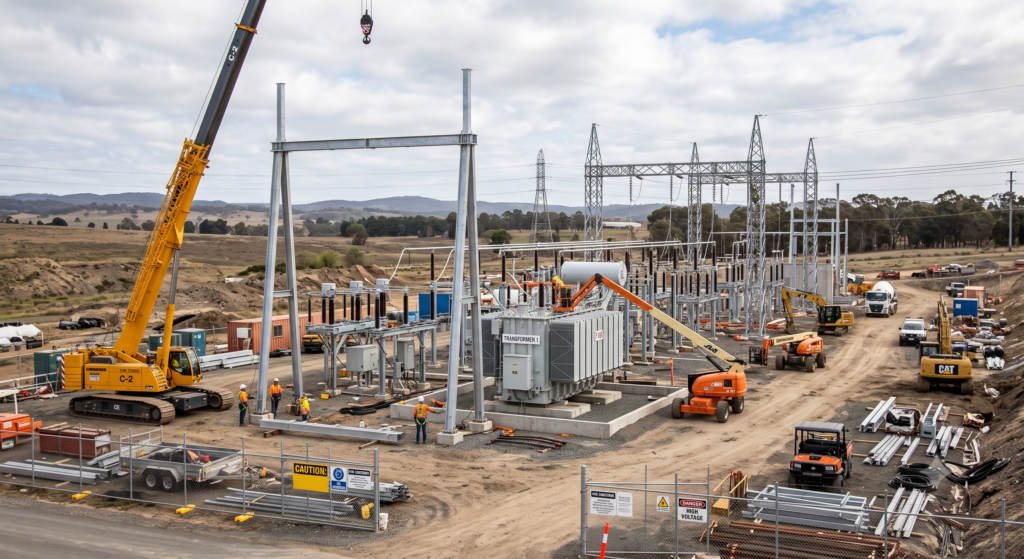
Substation construction is the end-to-end process of building an electrical substation: the fenced facility of transformers, switchgear, busbars, and protection equipment that steps voltage up or down as power moves through the grid. A typical project covers site selection, engineering design, permitting, equipment procurement, civil and structural work, electrical installation, and testing before the substation is energized.
That’s the textbook answer. Here’s the context that matters.
Substations sit at every junction of the grid. Without new ones, utilities can’t connect new generation, serve growing load, or replace aging infrastructure. That’s a big part of why investor-owned utilities plan to invest roughly $1.4 trillion in the grid between 2026 and 2030, according to the Edison Electric Institute.
And here’s what most people get wrong about electrical substation construction: the hard part usually isn’t the construction. It’s the procurement, the permitting, the remote sites with no AC power, and the challenge of overseeing several builds at once with a limited engineering staff.
The steel and concrete are the headline. The oversight is the real story.
LG&E and KU lived this exact problem
Louisville Gas & Electric and Kentucky Utilities were running multiple greenfield substation builds simultaneously. Remote locations. Long drives for every site visit. No AC power on site. Growing theft concerns.
They put solar-powered construction cameras on every project. Remote live viewing replaced most of the routine drives. Time-lapse footage documented milestones for training and management reporting. And when tools were stolen overnight on an active site, the built-in security recording caught it and helped get the equipment back.
“Long duration and complex construction associated with building a substation requires significant oversight, and these cameras allow for constant progress status and check-ins remotely without having to make long, time-consuming drives.” — Brandon Thompson, Sr. Manager, LG&E and KU
The full LG&E and KU substation security case study is worth a read if you’re managing anything similar.
Not all substations are the same build
The type dictates the footprint, equipment, schedule, and budget:
- Transmission substations connect transmission lines and switch high voltages (115 kV and up). The biggest, most complex builds.
- Distribution substations step transmission voltage down to local delivery levels (typically 4–35 kV). The most common project type.
- Switching stations route power between lines at one voltage level. No transformers.
- Collector substations aggregate output from wind and solar farms, a fast-growing category as renewable interconnections stack up.
Most projects are air-insulated (AIS) outdoor yards. Gas-insulated (GIS) designs fit a much smaller footprint at a much higher cost, which is why you see them on urban and space-constrained sites. Rural greenfield builds are overwhelmingly AIS.
Why data centers are driving substation demand
A growing share of new substation projects exist because of a single driver: data centers. Hyperscale and AI data center campuses can pull 100+ MW each, and utilities are responding with new distribution and collector substations built specifically to serve that load. Some data center developers are even funding dedicated substations to secure grid capacity faster than a standard interconnection queue would allow.
That changes the profile of the build. These are often fast-tracked, high-visibility projects with corporate stakeholders watching progress closely, and they carry the same remote-site, no-power, high-theft-risk characteristics as any other greenfield substation, just with less schedule slack. The oversight problem doesn’t go away because the customer is a tech company instead of a utility. If anything, the pressure to document progress and avoid delays goes up.
The Substation Design and Construction Process: 7 Phases
Substation design and construction runs a fairly consistent sequence whether you’re building a small distribution station or a major transmission hub. Here’s how it actually goes.
Phase 1: Planning and site selection
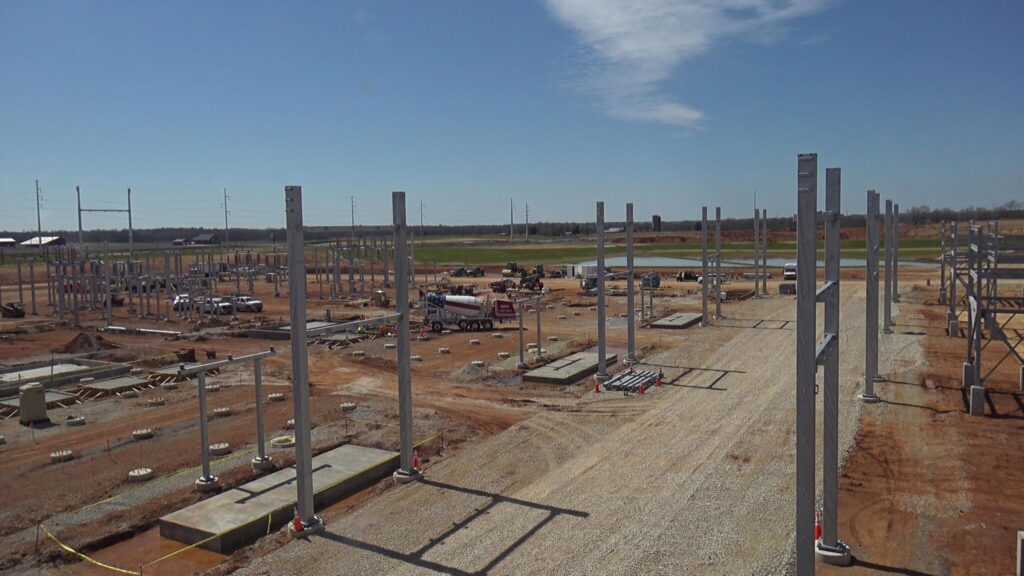
Load forecasting and system studies identify the need. Then candidate sites get evaluated for proximity to existing lines, soil, drainage, access, and environmental constraints. Greenfield sites are the norm, which means no utilities, no security, and sometimes no paved road in.
One thing experienced teams say over and over: plan for construction-phase power and security on day one. Permanent power often shows up months into the job, and everything from your field office to your site monitoring depends on that gap being covered.
Phase 2: Engineering and design
One-line diagram, physical layout, grounding grid, structural designs, protection and control schemes. Design typically runs 4–9 months depending on complexity and interconnection requirements.
Phase 3: Permitting and procurement
Permits run in parallel with long-lead equipment orders, and this phase drives the schedule on almost every project. Large power transformers currently carry lead times measured in years, not months. Ordering before design is final isn’t cutting corners anymore. It’s standard practice.
Phase 4: Civil and site work
Clearing, grading, drainage, the grounding grid, foundations, access roads, perimeter fencing. The ground grid is one of the most safety-critical installations on the entire project. It protects workers and equipment from fault currents for the life of the facility.
Phase 5: Structural and equipment installation
Steel goes up, then the major apparatus: transformers on specialized heavy-haul transport, circuit breakers, disconnect switches, buswork. Transformer delivery day is the highest-visibility milestone on the job, and the one owners most often want documented on camera.
Phase 6: Wiring, protection, and control
Control buildings, thousands of control cable terminations, protective relays, SCADA, communications. Errors here don’t show up until commissioning, so point-to-point testing and quality control matter enormously.
Phase 7: Testing, commissioning, and energization
Every device gets function-tested, relay settings verified, then staged energization. The documentation from construction (photos, footage, test records) becomes part of the permanent asset record. Teams that captured it continuously are glad they did. Teams that didn’t are reconstructing it from memory.
How long does substation construction actually take?
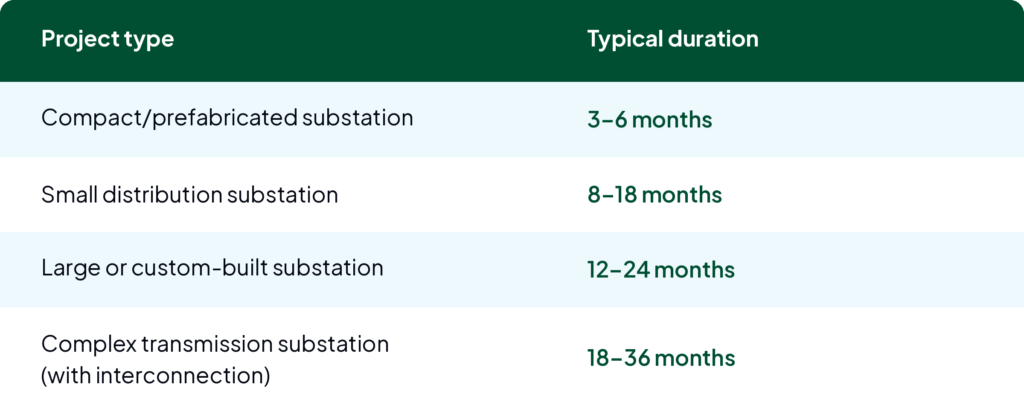
Here’s the part nobody likes hearing: procurement, not fieldwork, is usually the constraint. Utility interconnection timelines of 18–24 months generally can’t be compressed with more budget. What you can control is avoiding rework, catching problems early, and documenting progress. That’s where oversight earns its keep.
What does it cost?
Costs vary widely with voltage class, capacity, and site conditions. A compact distribution substation might run a few hundred thousand dollars; a major transmission substation can reach tens of millions. Major equipment is consistently the biggest share of the budget, and the power transformer is the single largest line item on nearly every project.
That equipment concentration has a security implication. A substation site mid-construction holds hundreds of thousands of dollars in copper, tools, and apparatus behind temporary fencing, in a location nobody drives past at night. That’s not a hypothetical risk profile. That’s a target.
Where substation building construction goes sideways
Theft and unauthorized access. The Department of Energy estimates copper theft costs U.S. businesses around $1 billion every year, and physical security incidents at grid facilities have climbed sharply. Construction-phase substations check every box thieves look for: high copper content, valuable tools, remote location, nobody around. The fix is layered security before permanent infrastructure exists: solar-powered cameras with continuous recording, motion alerts, signage, secured laydown areas. LG&E and KU recovered stolen tools because the footage existed. Most teams in that situation have nothing.
No AC power on greenfield sites. Permanent power arrives late in the schedule, which complicates everything that needs electricity, including monitoring. Solar-powered camera packages run independently of jobsite power from day one. This is a solved problem; teams just have to plan for it.
Too many sites, not enough windshield time. Utilities routinely run several substation builds at once, hours apart by car. Every drive is unrecoverable engineering time. Remote live viewing lets project engineers check every site daily without leaving the office. Reduced travel is the operational win teams mention first, every time.
Documentation gaps. Disputes, training, and management reporting all demand a visual record, and you can’t reconstruct one after the fact. LG&E and KU use their time-lapse footage for management presentations and to teach newer engineers how substation phases actually unfold. That’s the difference between documentation as a chore and documentation as an asset.
You can’t manage what you can’t see. And on a multi-site substation program, there’s more to see than ever.
Frequently Asked Questions About Substation Construction
Substation construction is the process of building an electrical substation: the fenced facility of transformers, switchgear, and protection equipment that raises or lowers voltage as power moves through the grid. A typical project includes site selection, engineering design, permitting, equipment procurement, civil work, electrical installation, and commissioning, and takes roughly 8–24 months depending on size and complexity.
Most substations take 8 to 18 months to build, while large or complex transmission substations can take 18 to 36 months from design through energization. Equipment lead times, especially power transformers, are usually the schedule driver.
Substation costs range from a few hundred thousand dollars for compact distribution units to tens of millions for major transmission facilities. Voltage class, capacity, and site conditions drive the total, and major equipment, led by the power transformer, is the largest share of the budget.
The seven core phases are planning and site selection, engineering and design, permitting and procurement, civil and site work, structural and equipment installation, wiring and protection/control, and testing and commissioning.
Effective substation site security combines perimeter fencing, signage, secured equipment storage, and remote cameras with continuous security recording and motion alerts. Because most sites lack AC power during construction, solar-powered cameras are the standard approach. LG&E and KU used them to capture an overnight tool theft and support recovery.
Transmission substations handle 115 kV and above, involve larger equipment and footprints, and take longer to build. Distribution substations step power down to local delivery voltages (4–35 kV), are smaller, and make up the majority of substation construction projects.
The bottom line on substation construction
Substation construction is a long, capital-intensive process where the biggest risks (procurement delays, theft, oversight gaps across remote sites) live outside the fence line of traditional project management. The teams running these projects well treat visibility as infrastructure. They can see every site, every day, from groundbreaking to energization.
That’s what LG&E and KU did, and it paid off in recovered equipment, fewer drive hours, and a complete visual record of every build.
If you’re building a substation, or a whole program of them, that’s the world we work in. Reach out and let’s talk about what full-site visibility looks like on a project like yours. Get a quote here.
As of 2026. Cost and timeline figures are industry benchmarks; actual projects vary with voltage class, site conditions, and market lead times.