This guide is for commercial project managers evaluating panoramic cameras for active jobsites. It covers what to look for, what separates a camera from a jobsite intelligence platform, and why the wrong choice costs more than the camera itself.
A panoramic security camera on a commercial jobsite captures 180° to 360° of continuous coverage across active work zones, giving project managers remote visibility without requiring multiple fixed-angle units or dedicated on-site personnel. On large commercial projects (ground-up office buildings, multifamily, industrial tilt-up, healthcare) where a single pour or framing sequence can represent $500K or more in labor and material, that wide-angle view is not a luxury. It is the difference between managing a project and guessing at one.
Most PMs searching for panoramic security cameras are really looking for something the word “security” doesn’t fully cover: live jobsite intelligence. Footage for dispute resolution. Subcontractor accountability. Proof-of-progress tied to draw requests. A panoramic camera that merely records without enabling real-time access, timestamped documentation, or cloud retrieval is just an expensive hard drive on a pole.
A panoramic security camera uses a wide-angle or multi-sensor lens system to capture 180°–360° of scene in a single frame, while a standard PTZ (pan-tilt-zoom) camera only covers a narrow cone of roughly 60°–90° and must be manually or automatically directed. On a commercial jobsite, that distinction has real operational consequences.
A 50,000 SF tilt-up warehouse under construction might have concrete crews at the north end, steel erection at center, and MEP rough-in happening in the southeast corner. All at the same time. A standard camera pointed at one zone misses everything else. A properly positioned panoramic unit captures all three in a single live feed.
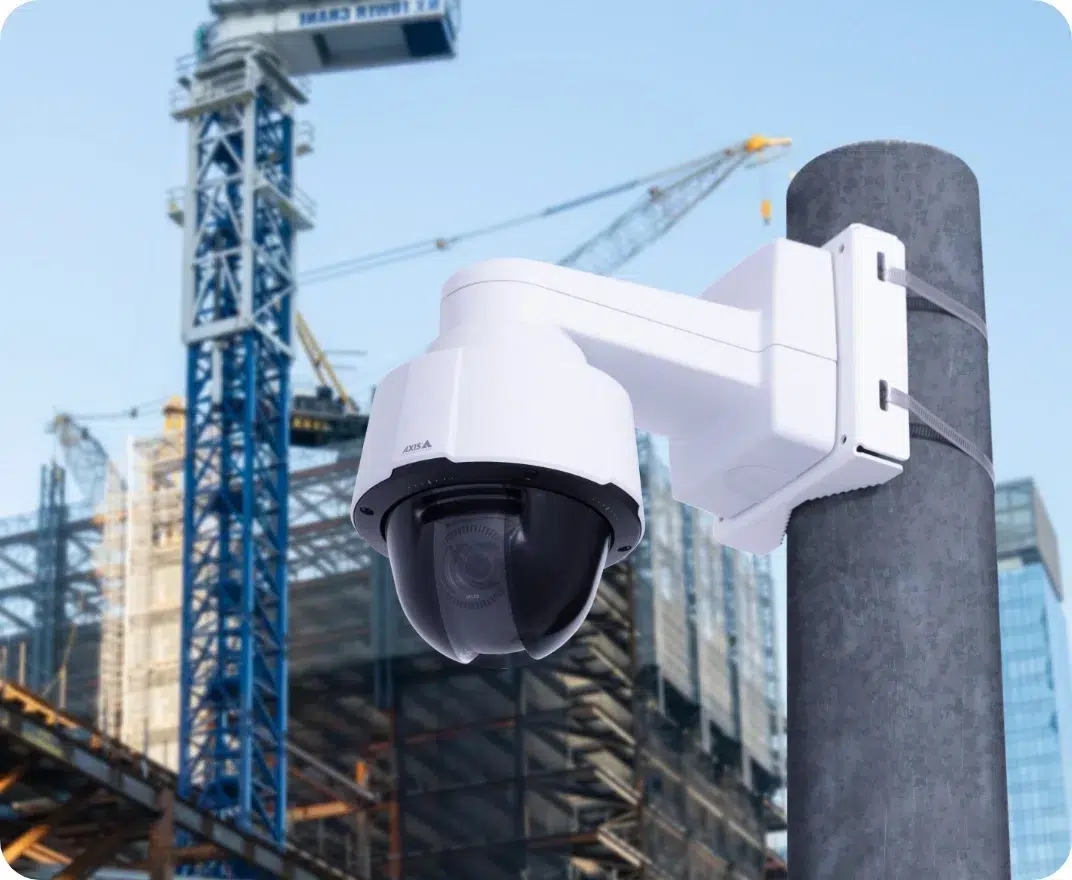
TrueLook panoramic camera deployed on an active commercial jobsite.
That said, panoramic coverage is not a substitute for clarity. High-resolution panoramic cameras on commercial jobsites should deliver at least 4K or multi-megapixel resolution to retain usable detail when digitally zooming into a specific trade zone within the wider frame. Lower-resolution wide-angle units produce footage that looks comprehensive but becomes blurry and legally useless the moment a PM needs to verify which crew was in a specific location at a specific time.
Subcontractor accountability is the use case that converts most commercial PMs from skeptical to convinced. A panoramic security camera with timestamped cloud access allows a project manager to verify crew presence, work sequence, and activity level across multiple trade zones, from any location, without a site visit.
Practically, this plays out in several ways:
| Accountability Scenario | Without Panoramic Coverage | With Panoramic Coverage |
|---|---|---|
| Subcontractor disputes crew hours billed | He said / she said with no paper trail to resolve it | Timestamped footage confirms arrival, departure, crew count |
| Owner questions progress on draw request | PM sends photos taken during last site visit, which may be days old | Live or same-day footage confirms current state of work in place |
| Damage or theft claim by subcontractor | No visual record; claim is paid or disputed blind | Footage isolates the time window; claim validated or refuted |
| OSHA safety incident investigation (29 CFR 1926) | Incident reconstruction relies on witness accounts | Visual record supports or corrects incident timeline |
| Liquidated damages dispute (LD clause) | Contractor claims weather; owner disputes; no objective record | Panoramic time-lapse documents actual site activity by day |
On projects running AIA A201 General Conditions, the standard contract document governing most commercial GC work, the documentation burden falls squarely on the contractor for change order (CO) justification and schedule impact claims. Panoramic jobsite footage tied to a timestamped cloud archive gives a project manager defensible, date-stamped evidence that directly supports or counters CO claims, schedule submissions, and OSHA 300 Log incident records.
Field of view matters less than resolution within that field. A 360° camera producing 2MP of total resolution averages less than 0.5MP per quadrant. That is not enough to read a high-vis vest number or verify which concrete batch ticket is being poured. For commercial construction, a panoramic security camera should produce at least 8–12MP total across its field of view to maintain actionable detail when zooming into any portion of the frame.
The camera is a data collection device. The platform behind it determines whether that data is useful. PMs running multiple active jobsites simultaneously (most commercial PMs in growth markets) cannot physically be at every camera to review footage. Cloud-native platforms allow live streaming, historical scrubbing, and clip sharing from a phone or laptop without on-site IT infrastructure.
Most commercial sites lack permanent power infrastructure during the early construction phases, exactly when panoramic coverage matters most. Solar-powered panoramic jobsite cameras with cellular connectivity eliminate the need for hardwired power or on-site internet, enabling deployment within hours of site mobilization with no electrician required. This is particularly relevant for phased projects where crews are active far from the contractor’s on-site trailer.
A panoramic camera that builds an automatic time-lapse archive is worth significantly more than one that does not. Progress documentation tied to the schedule of values (SOV) supports draw requests, protects against retainage disputes, and provides an irreplaceable record if a project ends in litigation.
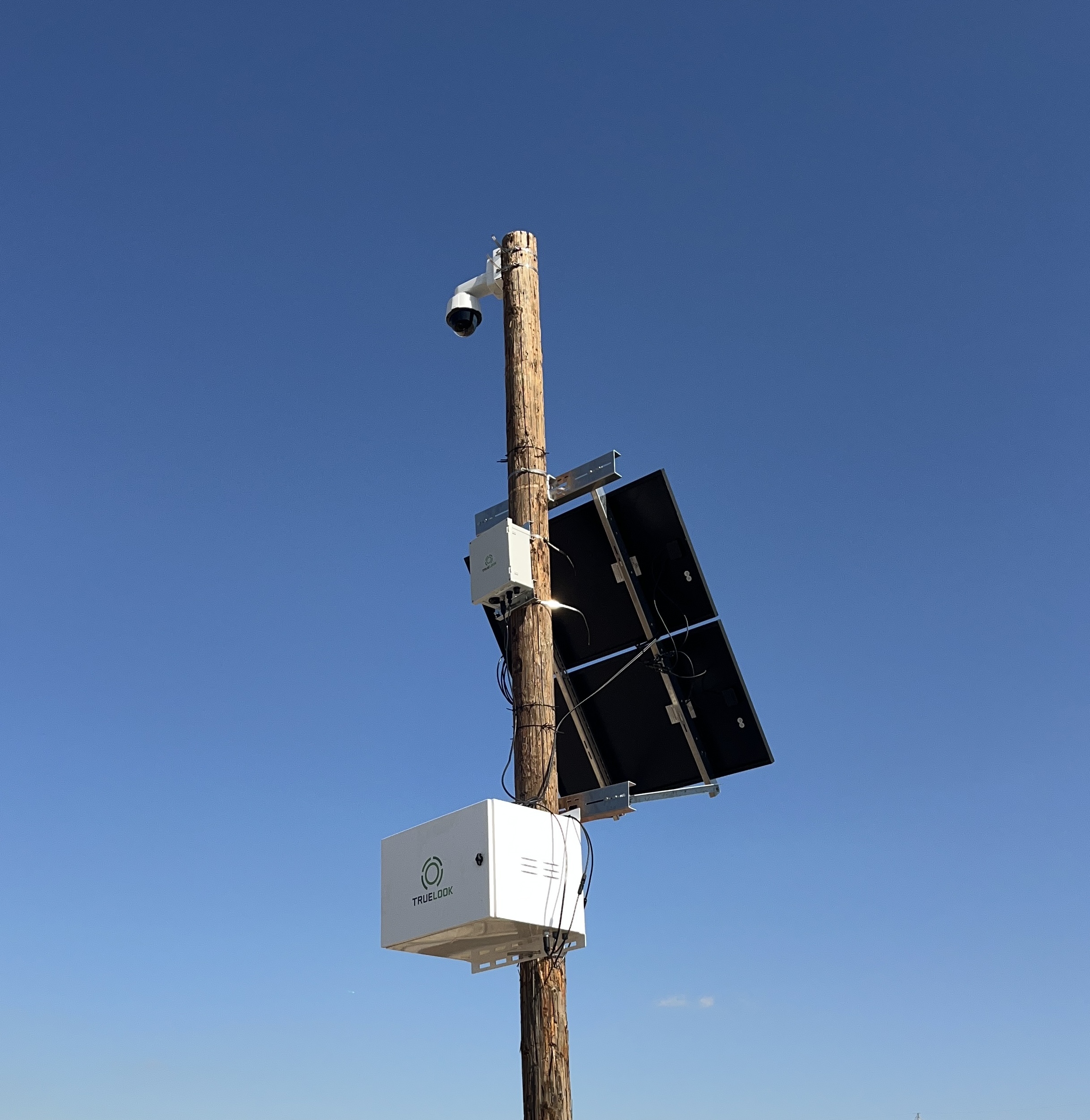
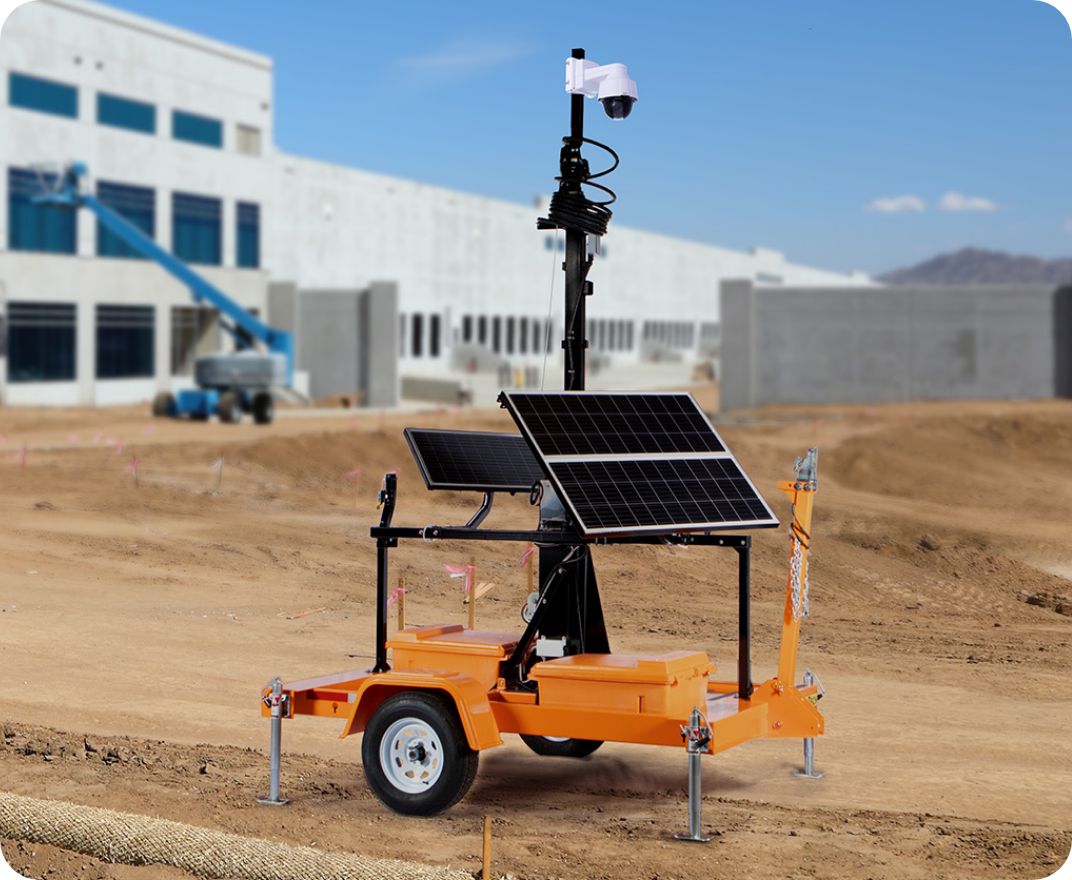
TrueLook cameras deploy on fixed pole mounts or mobile trailer units, with no hardwired power required.
This is the question most PMs don’t know to ask until they’ve already bought the wrong thing. A panoramic security camera captures footage, while a jobsite intelligence platform converts that footage into searchable, shareable, timestamped documentation that integrates with project management workflows.
The hardware is the how. The platform is the what. A PM who buys a standalone panoramic camera and stores footage locally has acquired a recording device. A PM whose camera feeds a cloud platform with automatic archiving, mobile access, clip sharing, and time-lapse generation has acquired jobsite intelligence.
Commercial construction projects operate under real documentation requirements: AIA contract deliverables, OSHA 29 CFR 1926 safety records, lender-required progress reports, and owner-driven inspection schedules. A panoramic camera that lives in a vacuum with no platform, no cloud, no workflow does not satisfy any of those requirements. It just creates a locally stored archive that nobody looks at until something goes wrong.
Frequently Asked Questions
Key Takeaways
- A panoramic security camera on a commercial jobsite captures 180°–360° of coverage in a single frame, eliminating the blind spots that PTZ cameras create when directed away from active work zones.
- Minimum 8–12MP total resolution is required to maintain actionable detail when zooming into specific zones within a wide-angle frame. Lower-resolution units produce footage that fails in disputes and investigations.
- Solar-powered, cellular-connected units can be deployed on day one of site mobilization with no hardwired power or IT infrastructure. The most common deployment mistake is waiting until temporary power is established.
- Cloud-archived, timestamped footage from a panoramic camera is legally defensible in change order disputes, OSHA investigations (29 CFR 1926), and liquidated damages claims. Locally stored footage with editable metadata is not.
- A standalone panoramic camera is a recording device. A jobsite intelligence platform is what converts that footage into operational documentation, remote visibility, and project management value.
- Camera program costs for commercial projects typically represent less than 0.1% of total project value, well below the cost of a single unresolved subcontractor dispute or a missed draw cycle.