A construction time-lapse service handles the whole job for you: camera placement, power and connectivity, footage capture over the life of the project, editing, and delivery of a finished video. You don’t touch a camera or a settings menu. That’s the difference between hiring a service and buying a time-lapse camera to run yourself.
If you’re comparing providers, the decision usually comes down to a handful of things: image quality, how long footage is stored, how fast you get an edited video back, and whether the service can also give you live access to the site while the project is underway, not just a highlight reel at the end.
What a Construction Time-Lapse Service Actually Includes
A real service goes further than “camera on a pole.” Look for these pieces:
- Site survey and camera placement. Someone figures out where the camera needs to sit to capture the whole sequence, not just the first phase.
- Power and connectivity handled for you. Solar power and cellular data are standard now, so you’re not running conduit to a camera just to get footage.
- Continuous capture for the life of the project. Weeks or months of images, not a single day’s shoot.
- Editing and production. Someone compresses months of stills into a watchable video, with music, transitions, and pacing that doesn’t put your client to sleep.
- Delivery in a usable format. A finished video you can drop into a proposal, a website, or a ribbon-cutting presentation without extra work on your end.
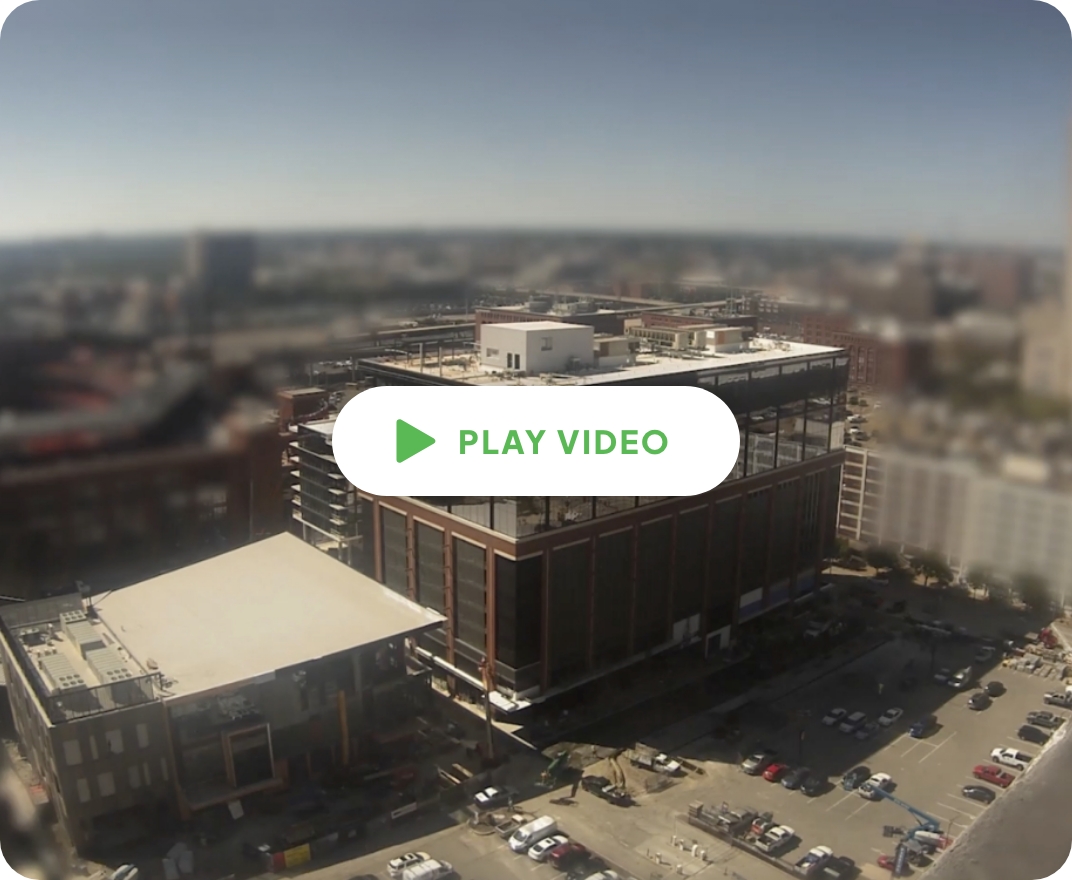
Some providers bundle this with live jobsite video too, so you get day-to-day monitoring and the long-term time-lapse from the same setup. TrueLook’s job site camera platform works that way. One camera, two outputs.
What Separates a Good Time-Lapse Service From a Weak One
Not every provider offering “time-lapse” delivers the same thing. Before you sign a contract, ask about these:
- Camera quality and positioning. A wide, high-resolution shot that covers the full site beats a narrow shot that misses half the action. Ask to see a sample video from a project similar in size and duration to yours.
- Footage ownership. Find out if you own the raw images and the final video, or if you’re licensing access. This matters if you want to reuse the footage later for a different marketing piece or a legal dispute.
- Storage and access during the project. Some services only deliver the final edited video at project close. Others give you live access to the raw feed the whole time, which is useful if a superintendent needs to check site progress from the office instead of driving over.
- Turnaround time. Ask how long it takes to get an edited video after the project wraps. A service that takes three months to hand over footage isn’t much use for a ribbon-cutting event happening next week.
- Support if something breaks. Cameras lose power, cell signal drops, weather happens. Ask who’s responsible for noticing and fixing a dead feed, and how fast they respond.
How Much Does a Construction Time-Lapse Service Cost
Pricing usually comes down to two models: a flat fee for the length of the project, or a monthly subscription that also covers live camera access. What you pay depends on how long the project runs, how many cameras are on site, the image resolution, and whether editing and production are part of the package.
That last piece is where the real difference in cost shows up. A basic time-lapse captures images on a schedule and hands you the raw file. A premium time-lapse service takes it further. Someone edits the footage, cuts it down to the moments that actually matter, and delivers something polished enough to hand to a client or post on your website without you having to touch it.
If you already run a jobsite camera for live view or security, standard time-lapse is often available as an add-on to that same camera instead of a separate system. Premium time-lapse builds on top of that. You’re not just adding a capture feature, you’re adding a production team.
Don’t compare quotes on price alone. Compare what’s actually included. A cheaper quote that skips editing, storage, or support isn’t actually cheaper. Someone on your team ends up doing that work instead, and their time isn’t free either.
What You Actually Get When the Project Wraps
A finished construction time-lapse does more than look good on a reel. Contractors use it for:
- Bid packages. A polished project video sets you apart from a competitor submitting a stack of static photos.
- Marketing and social content. One video gets cut into clips for a website, LinkedIn, and a highlight reel for future bids.
- Client and stakeholder updates. Owners and investors get a visual sense of progress without reading a status report.
- Dispute documentation. Continuous footage can show what actually happened on site during a disagreement over schedule or damage.
- Ribbon-cutting and grand opening events. A “from groundbreaking to grand opening” video is a standard piece of most completion ceremonies.
As competition for new work stays tight, a finished project video is one of the more visible ways to differentiate a bid package. The Associated General Contractors of America tracks how contractors are adapting their marketing and business development approach as project acquisition gets more competitive, and construction spending data from the U.S. Census Bureau shows just how much activity firms are competing against for the same pool of work.
Time-Lapse Service vs. Buying Your Own Camera
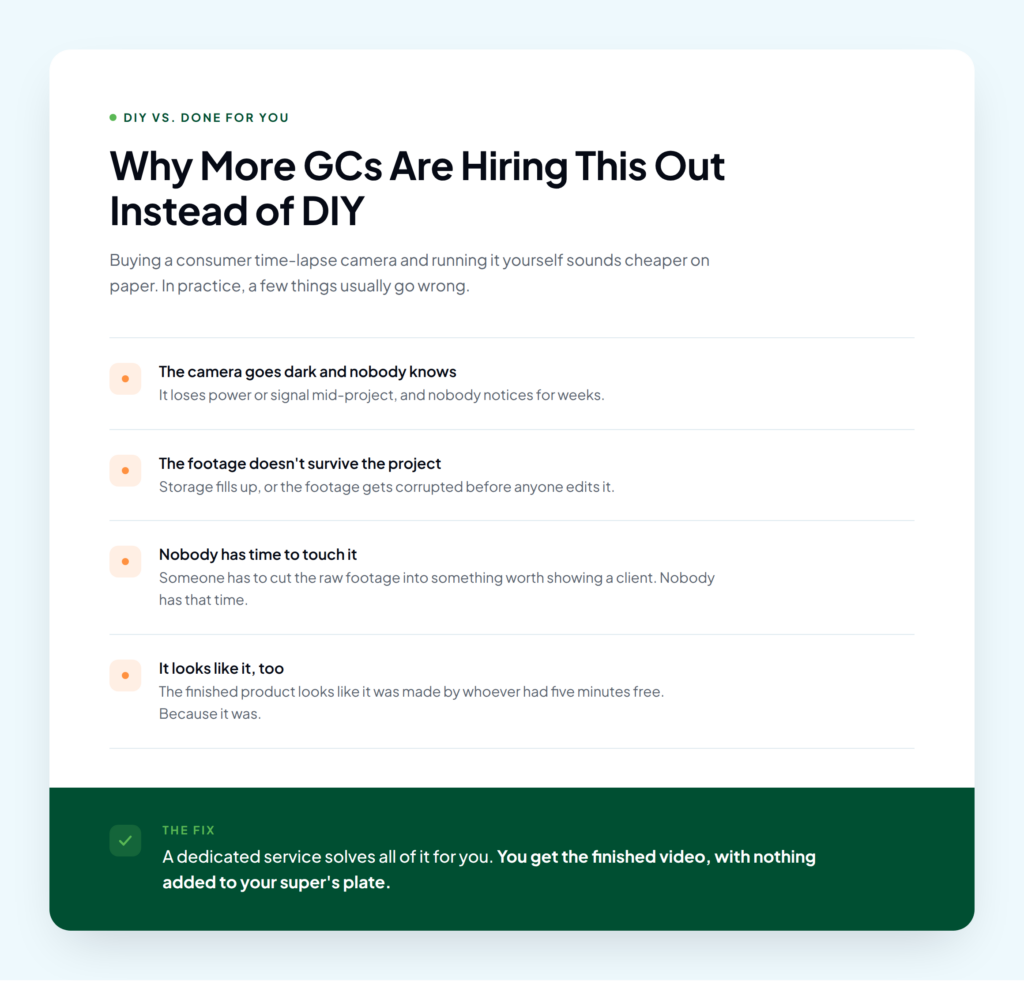
If you only need footage for a single short project, buying a basic camera might make sense. For most GCs running multiple active jobs, a service wins out for a simple reason: reliability. A service provider is accountable for uptime, storage, and delivery. A camera you bought and forgot about is accountable to no one until something goes wrong.
Trade publications like Construction Dive have covered the broader trend of GCs adopting jobsite technology that requires less hands-on management from field staff, which is exactly the appeal of a managed time-lapse service over a DIY setup.
FAQ
It’s a managed service where a provider installs a camera, captures footage for the length of a project, and delivers an edited time-lapse video. It typically includes power, connectivity, storage, and editing, so you don’t manage any of it yourself.
This varies by provider. Ask upfront what the turnaround is after project completion, especially if you need the video for a specific event like a ribbon-cutting.
Some providers offer this as part of the same setup. TrueLook’s Premium Time-Lapse service pairs long-term time-lapse capture with live jobsite viewing from the same camera.
Ownership terms vary by provider. Confirm this before signing so you know whether you can reuse the video and images for future marketing.
Getting Started
If you’re comparing time-lapse providers, the fastest way to judge quality is to watch a finished video from a project close to your own in size and length. You can see what a full-service setup looks like, camera to finished video here.