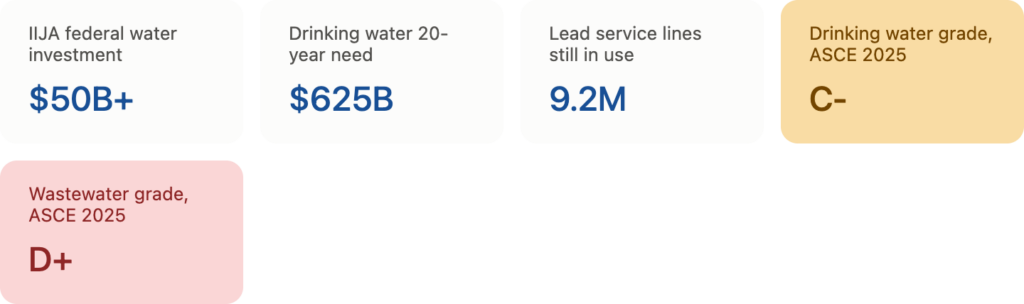
The Infrastructure Investment and Jobs Act delivered more than $50 billion to EPA for drinking water, wastewater, and stormwater infrastructure, the largest federal water infrastructure investment in history, and the American Society of Civil Engineers still graded the country’s drinking water systems at a C-minus and wastewater systems at a D-plus in its 2025 Infrastructure Report Card.
EPA’s own 2023 assessment puts the nation’s drinking water infrastructure needs at $625 billion over the next 20 years, more than $150 billion higher than its 2018 estimate, and 9.2 million lead service lines are still in operation nationwide.
Everyone is talking about the funding. Almost nobody is talking about what actually happens once that money hits a jobsite.
That’s the gap this guide covers. If you’re planning, bidding, or managing water treatment plant construction or wastewater treatment plant construction, here’s what the reports don’t tell you.
Key Takeaways
- Water treatment plants purify raw water for drinking; wastewater treatment plants treat used water before discharge or reuse. They’re regulated under different federal laws and shouldn’t be bid or planned as interchangeable projects.
- Municipal water treatment plant construction typically takes two to five years from planning through commissioning, depending on plant size and complexity.
- EPA estimates $625 billion in 20-year drinking water capital needs, and ASCE projects the drinking water investment gap will grow from $309 billion in 2024 to $620 billion by 2043, driven by aging infrastructure, population growth, and new PFAS regulations finalized in 2024.
- The core civil and process engineering on these builds is well understood. What actually derails schedules are subcontractor coordination issues, missed regulatory inspection windows, and disputes without documentation.
- Remote and semi-secured treatment plant sites are common theft and vandalism targets after hours, making jobsite visibility a real risk-management tool, not just a nice-to-have.
What Is Water Treatment Plant Construction?
Water treatment plant construction is the process of designing, permitting, and building a facility that removes contaminants from water to make it safe for a specific use, either for public drinking water (potable treatment) or before it’s released back into the environment or reused (wastewater treatment).
That’s the textbook answer. Here’s the context that matters: these two categories get lumped together constantly, but they’re built for opposite jobs.
- Water treatment plants take raw water from a river, lake, reservoir, or aquifer and process it into safe drinking water for a community.
- Wastewater treatment plants take used water from homes, businesses, and industry and treat it before discharge or reuse. Nearly 17,500 of these plants currently operate across the U.S., up from just over 16,000 in 2012, with roughly 200 more expected online by 2042.
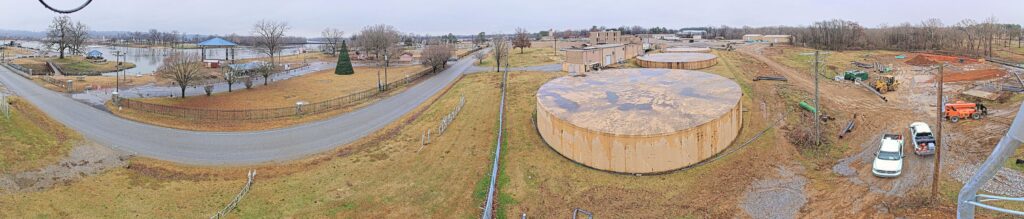
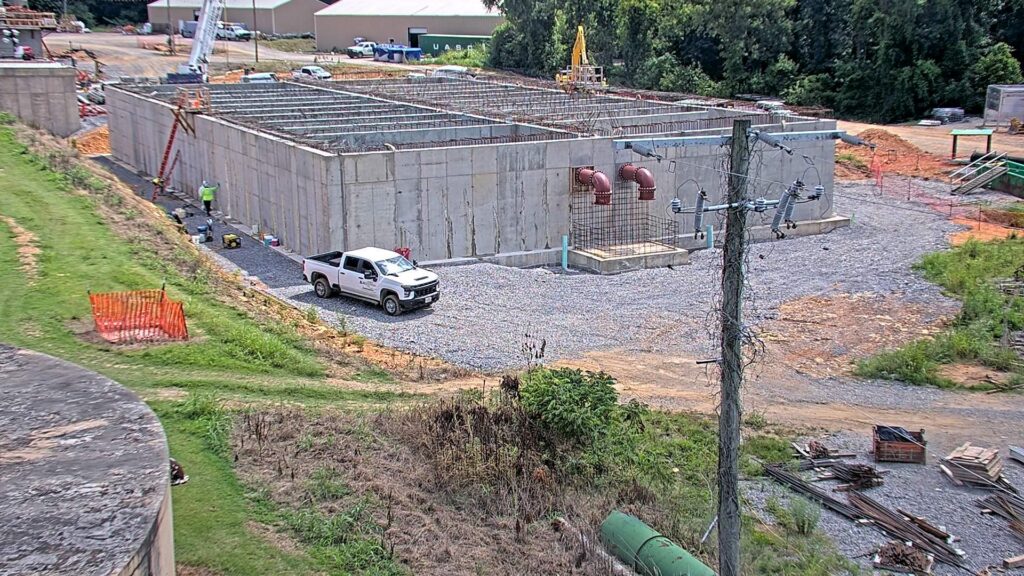
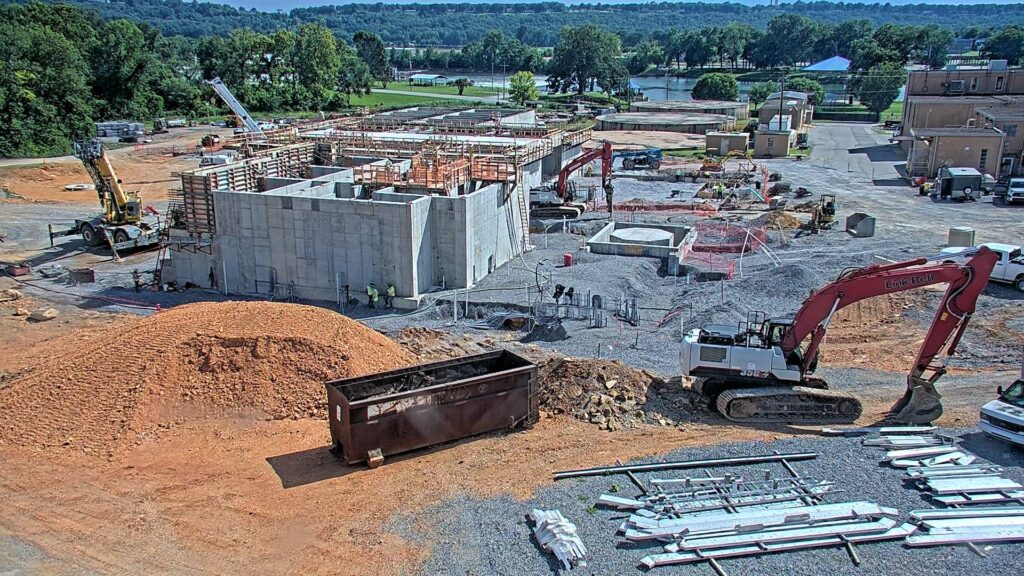
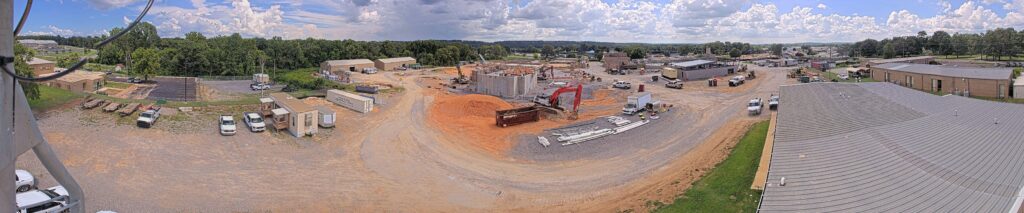
Construction of a water treatment plant and construction of a wastewater treatment plant share a lot of the same civil, mechanical, and electrical scope. But the process trains, the permitting bodies, and the regulatory standards are different. Anyone bidding both types of work needs to treat them as related but distinct projects, not interchangeable ones.
Why Water Treatment Construction Is Accelerating Right Now
The EPA’s most recent Drinking Water Infrastructure Needs Survey put the 20-year capital need for U.S. drinking water systems at roughly $625 billion. ASCE’s 2024 Bridging the Gap economic study found the projected gap between drinking water infrastructure needs and investment stood at $309 billion in 2024, expected to grow to $620 billion by 2043. On the wastewater side, combined wastewater and stormwater capital needs hit $99 billion in 2024, against a $69 billion funding gap, meaning only about 30% of the sector’s capital needs are currently being met. That gap is projected to top $690 billion by 2044.
Here’s what most people get wrong about those numbers: it’s not one type of project. It’s thousands of aging plants, expanding municipalities, and PFAS-driven upgrades all competing for the same pool of contractors and engineers at the same time.
Three forces are driving the current wave of construction water treatment work:
- Aging infrastructure: Many treatment plants in operation today were built 40 to 60 years ago and are past their design life.
- Population growth in fast-growing metros: Municipalities in the Sun Belt and parts of the Mountain West are permitting new plants to keep up with demand, not just repairing old ones.
- New regulatory requirements, particularly EPA PFAS drinking water standards finalized in 2024, are forcing utilities to retrofit or rebuild treatment trains they hadn’t planned to touch for another decade. Only 38% of existing treatment plants currently provide advanced treatment capable of meeting these standards, a figure expected to rise to just 42% over the next 20 years even with the current construction wave underway.
That last one is the piece I think about most. A regulatory deadline doesn’t care whether your GC has capacity. It just moves the whole industry’s schedule up at once.
The Phases of Water Treatment Plant Construction
Water treatment plant construction typically moves through five phases. Each one has its own risk profile.
Phase 1: Planning and permitting. Utilities and municipalities work with engineering firms to size the plant, select a treatment process, and secure permits from state environmental agencies and, for larger projects, the EPA. This phase can take 12 to 24 months before a shovel ever hits dirt.
Phase 2: Site preparation and civil work. Grading, excavation, and foundation work for basins, clarifiers, and filter structures. This is where underground utility conflicts and soil conditions most often blow up a schedule.
Phase 3: Structural and process construction. Concrete tanks, filter galleries, chemical feed buildings, and the piping and process equipment that actually does the treatment work.
Phase 4: Mechanical, electrical, and controls installation. Pumps, blowers, SCADA systems, and the instrumentation that lets operators run the plant remotely. This phase is where commissioning delays most often originate.
Phase 5: Startup, testing, and commissioning. The plant has to prove it can hit its permitted performance standards under real operating conditions before regulators sign off.
Most water treatment plant construction schedules run 24 to 48 months from groundbreaking to commissioning, depending on plant size and treatment complexity. Larger regional wastewater treatment plant construction projects can run longer.
Types of Treatment Processes You’ll See on These Projects
Not every plant is built the same way. The process selected during design drives almost everything downstream, from the footprint to the crew mix needed on site.
Common drinking water treatment processes:
- Conventional filtration (coagulation, flocculation, sedimentation, filtration)
- Membrane filtration (ultrafiltration and reverse osmosis)
- Disinfection (chlorination, UV, or ozone)
Common wastewater treatment processes:
- Primary treatment (physical settling of solids)
- Secondary treatment (biological processes, often activated sludge)
- Tertiary treatment (advanced filtration and nutrient removal before discharge)
Membrane and advanced tertiary systems are more common in new builds than they were a decade ago, largely because of tighter discharge limits and PFAS removal requirements. That shift adds specialized mechanical and instrumentation scope that a lot of general civil contractors haven’t built before.
Where Water Treatment Construction Projects Actually Go Sideways
Here’s the part nobody likes hearing: the civil and structural work is rarely what blows up the schedule. It’s everything happening around it.
- Multiple subcontractor trades on a tight, secured site: Civil, mechanical, electrical, and controls crews are often on site simultaneously, and treatment plants sit on land that’s frequently fenced, remote, or adjacent to active operating facilities. Coordination and access control both get harder.
- No documentation when a dispute happens: Change orders on process piping or equipment substitutions are common on these builds. Without visual documentation, “who approved what and when” becomes a he-said, she-said problem.
- Theft and vandalism at remote sites: Treatment plants are frequently built outside city centers, near reservoirs or rural discharge points, making copper, wiring, and equipment easy targets after hours.
- Regulatory inspection windows: Commissioning-phase inspections have hard deadlines. A missed inspection because a subcontractor wasn’t on site when scheduled can push a plant’s go-live date by weeks.
- Aging systems failing faster than they’re being replaced: The wastewater sector’s renewal and replacement rate for large capital projects actually dropped from 3% to 2% over the last decade, even as collection system failures rose from 2 to 3.3 per 100 miles of pipe. Nationwide, drinking water systems still see roughly 240,000 water main breaks a year, costing about $2.6 billion in repairs. Construction teams working near or tying into existing infrastructure are increasingly working around systems already failing in real time, not just aging on paper.
You can’t manage what you can’t see, and on a multi-phase, multi-trade site like this, there’s more to see than ever.
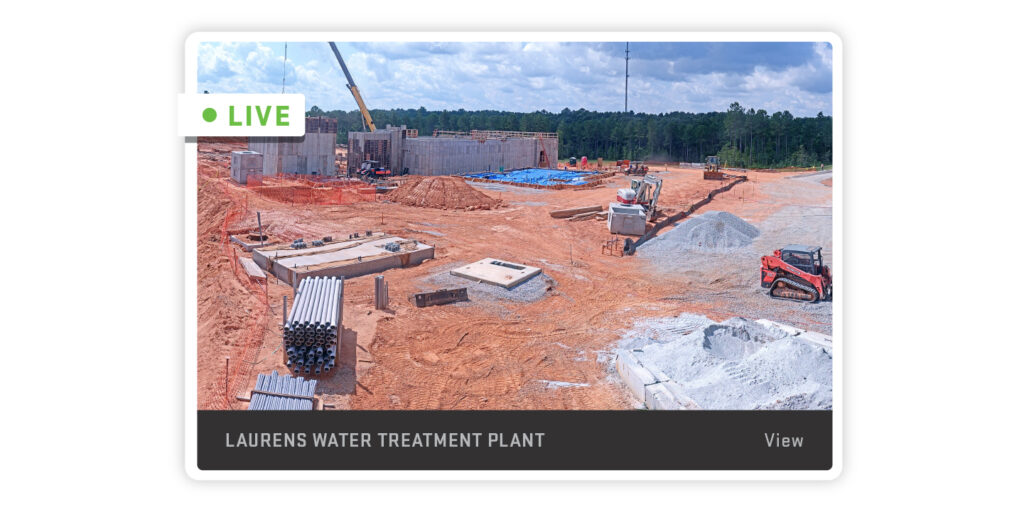
This is exactly where jobsite visibility earns its keep. On water and wastewater treatment plant construction projects, TrueLook’s cameras give owners, GCs, and engineers a documented record of subcontractor progress, site security after hours, and time-lapse documentation, all without needing someone physically on site to verify it. See how TrueLook supports large-scale infrastructure builds →
Water Treatment Plant Construction vs. Wastewater Treatment Plant Construction
| Factor | Water Treatment Plant | Wastewater Treatment Plant |
|---|---|---|
| Source | Raw water (river, lake, aquifer) | Used water from homes/industry |
| End goal | Safe drinking water | Safe discharge or reuse |
| Primary regulator | State drinking water agency, EPA (Safe Drinking Water Act) | State environmental agency, EPA (Clean Water Act) |
| Common processes | Coagulation, filtration, disinfection | Biological treatment, clarification, tertiary filtration |
| Typical site location | Near water source, often closer to population centers | Often lower elevation, near discharge point |
| Current ASCE grade | C- (2025) | D+ (2025) |
The Bottom Line on Water Treatment Plant Construction
Water and wastewater treatment plant construction is accelerating because of aging infrastructure, population growth, and new PFAS regulations, not because it’s suddenly gotten easier to build. The civil and process engineering challenges are well understood. The risk that actually threatens schedules and budgets is coordination, documentation, and security across a long, multi-trade build. That’s the part that doesn’t show up in the funding headlines, and it’s the part worth planning for before you break ground.
If you’re managing a water or wastewater treatment plant construction project, let’s talk about what full-site visibility looks like on a build like yours →
As of 2026. Cost, funding, and timeline figures referenced are drawn from EPA and ASCE 2025 Infrastructure Report Card public reporting; project-specific timelines vary with plant size, treatment process, and local permitting requirements.
Frequently Asked Questions
Most water treatment plant construction projects take 24 to 48 months from groundbreaking to commissioning, depending on plant size, treatment process complexity, and permitting timelines.
A water treatment plant processes raw water into safe drinking water. A wastewater treatment plant treats used water from homes and businesses before it’s discharged or reused. They serve opposite ends of the water cycle and are regulated under different federal laws (the Safe Drinking Water Act versus the Clean Water Act).
Construction of a water treatment plant typically includes site preparation, concrete basins and clarifiers, filter galleries, chemical feed systems, mechanical and electrical installation, SCADA controls, and a final commissioning and testing phase.
Aging infrastructure, population growth in fast-growing regions, and new EPA PFAS drinking water and discharge standards are driving a wave of new construction and retrofit projects nationwide. Only 38% of existing plants currently provide advanced treatment capable of meeting tightening standards.
Coordination across multiple simultaneous trades, missed regulatory inspection windows, and disputes over change orders without documentation are more common causes of delay than the core civil or process engineering work itself.
Nearly 17,500 publicly owned wastewater treatment plants currently operate across the U.S., according to ASCE’s 2025 Infrastructure Report Card, up from just over 16,000 in 2012. Roughly 200 additional plants are expected to come online by 2042.