What are solar powered security cameras and how do they work?
Solar powered security cameras are self-contained surveillance systems that generate their own electricity from sunlight instead of drawing from a wired power source. A solar panel converts sunlight into electrical current, a charge controller regulates that current into an onboard battery, and the camera draws stored power around the clock. Paired with 4G LTE cellular connectivity, the whole system can be deployed and monitored anywhere the sun reaches — no electrician, no trenching, no on-site network required.
Solar powered cameras deliver continuous monitoring anywhere the sun reaches — no electrician, no trenching, no power outlet required. They convert sunlight into electricity, store it in a high-capacity battery, and run the camera through the day, night, and periods of cloud cover without interruption.
For project managers, site supervisors, and security teams dealing with remote locations, temporary installations, or sites where running hardwired power is impractical or cost-prohibitive, solar powered cameras are often the only option that makes operational and financial sense.
This guide covers how solar powered cameras work, what’s inside them, their advantages and limitations, the best use cases, and what to evaluate when choosing one.
What Are Solar Powered Cameras?
Solar-powered cameras are surveillance systems that run entirely on energy captured from sunlight, stored in an onboard battery, rather than drawing from a hardwired electrical connection. They operate as self-contained units — the solar panel, battery, charge controller, and camera are all part of a single integrated system that can be deployed virtually anywhere with sun exposure.
Unlike traditional security cameras that require a direct connection to grid power, solar powered cameras are wireless in both power and, in most cases, data transmission. Combined with 4G LTE cellular connectivity, they can transmit live video, motion alerts, and recorded footage from remote locations with no on-site electrical or network infrastructure.
How Solar Powered Cameras Work
The system runs on a continuous cycle from sunlight to stored power to camera output:
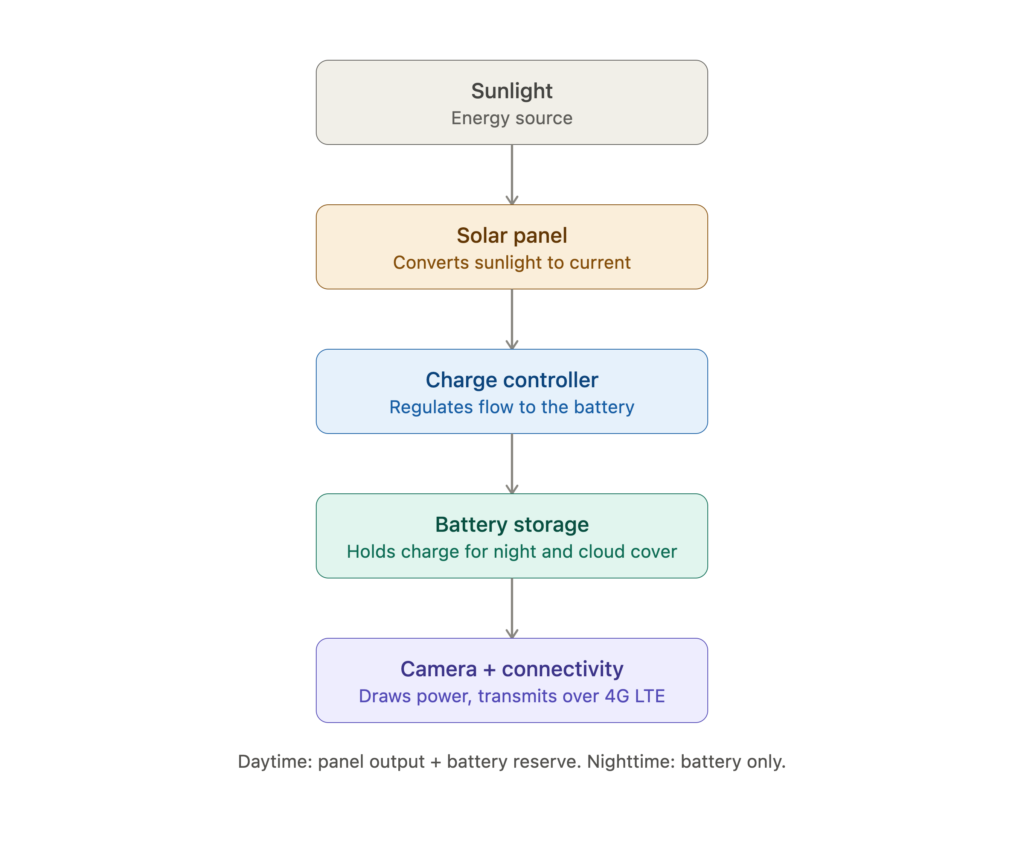
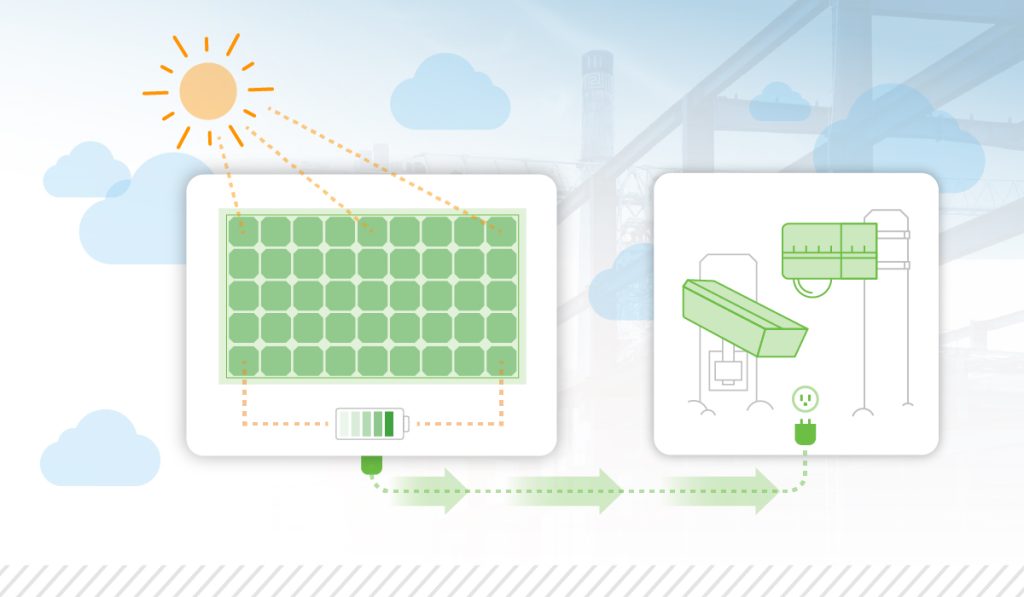
The system operates on a straightforward energy cycle. During daylight hours, the solar panel captures sunlight and converts it into electrical current. That current flows through a charge controller, which regulates the charge to protect the battery, and into the battery, where the energy is stored. The camera draws power continuously from the battery. During the day, it’s effectively running on real-time solar generation topped up by battery reserve, and at night it draws entirely from stored charge.
As long as the panel receives adequate sunlight over time to replenish what the camera consumes, the system runs indefinitely without any external power source. The key variables that determine how well the system holds up through low-sun periods are battery capacity and panel wattage. More of each means more buffer against cloudy days and reduced winter solar generation.
Key Components of a Solar Powered Camera System
Understanding the components inside a solar powered camera system helps you evaluate quality and compare systems accurately.
| Component | Function |
| Solar Panel | Captures sunlight and converts it to electrical current. Monocrystalline panels are standard on construction-grade solar-powered cameras for higher output per square foot. |
| Charge controller | Regulates current between the panel and the battery, preventing overcharging and protecting against complete discharge. |
| Battery Storage | Stores energy in watt-hours (Wh) to run the camera through nights and low-sun stretches. Lithium outperforms lead-acid in cold weather and lifespan. |
| Camera Unit | Fixed-position and pan-tilt-zoom (PTZ) cameras capture footage from your site, giving you time-lapse video to track jobsite progress remotely, along with high-resolution imaging, motion detection, and threat-deterrent functionality to keep the site secure. |
| Connectivity module | Built-in 4G LTE modem transmits video and alerts without on-site Wi-Fi. |
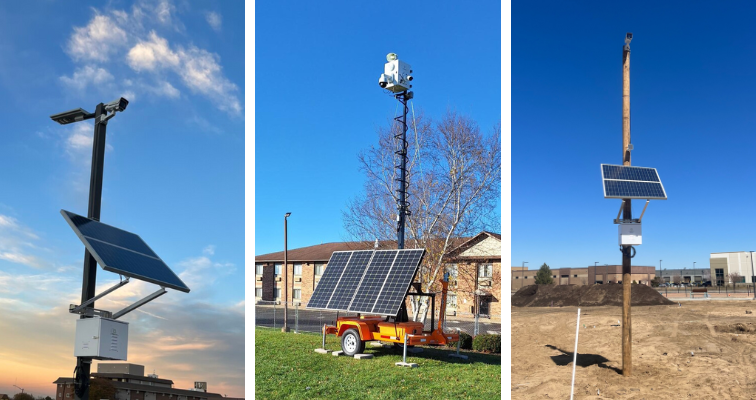
The solar-based nature of these cameras is a technological marvel in its own right, but many come with added features that make them invaluable security assets. You can view live footage remotely with mobile and desktop platforms while managers receive alerts when detecting motion.
Benefits of Solar-Powered Cameras
You might be hesitant to invest in a relatively new construction camera setup, but deploying a solar-powered solution has benefits you can’t ignore. Those benefits include:
- No Power Infrastructure Required: Solar powered cameras can be deployed anywhere the sun reaches. No electrician, no trenching, no utility coordination, no permits for electrical work. For remote jobsites, rural properties, or temporary installations where running conduit would cost more than the camera system itself, solar is the only practical option.
- Fast Deployment: A solar powered camera system can go from a truck bed to fully operational in hours. That speed matters on construction projects where timelines are tight, in security response situations where coverage is needed immediately, and on temporary installations where mobilization efficiency directly affects project economics.
- Relocatable as Site Conditions Change: Hardwired cameras are fixed to wherever power runs. Solar powered cameras mounted on poles, stands, or trailers can be repositioned as coverage needs shift — as a project progresses from foundation work to framing to exterior, or as security priorities change across a large site.
- Lower Lifecycle Cost on Power-Limited Sites: On sites where power is unavailable or expensive to bring in, solar powered cameras typically cost significantly less over a project’s lifecycle than hardwired alternatives — even accounting for the higher upfront hardware cost. Electrician labor, trenching, conduit, utility coordination, and ongoing power costs add up quickly on sites not built for camera infrastructure.
- Reliable Year-Round with Backup Power: Modern solar powered camera systems include multi-day battery backup — TrueLook’s solar powered construction cameras provide a minimum of five days of battery reserve. Combined with the option to connect to 110V power when solar generation is reduced in winter, they deliver reliable year-round performance without seasonal gaps in coverage.
These benefits make solar-powered options feel both advanced and essential. Construction firms like yours can deploy various configurations of these cameras on jobsites in cities or rural communities.
Drawbacks of Solar-Powered Cameras
No technology is without tradeoffs. Here’s an honest look at where solar powered cameras have limitations — and how to work around them.
- Dependence on Sunlight: Solar generation varies by season, geography, and local conditions. In northern climates during winter months, shorter days and lower sun angles can reduce solar output by 30–60% compared to peak summer performance. Consistently shaded locations such as under tree cover, between buildings, or in deep terrain, may not generate enough power to sustain a camera on solar alone year-round. The mitigation is choosing a system that supports a backup power source, so you can connect to a generator or outlet during low-solar periods without replacing hardware.
- Higher Upfront Cost: Solar powered camera systems carry a higher initial purchase price than equivalent wired cameras due to the panel, battery, and mounting hardware. That cost is typically recovered through eliminated power infrastructure expenses over the project lifecycle, but it requires a larger upfront commitment.
- Panel Maintenance: Solar panels need to be kept reasonably clean to maintain efficiency. Dust, debris, bird droppings, and snow accumulation reduce panel output over time. Routine cleaning is straightforward, but it’s a maintenance task that hardwired installations don’t require.
- Battery Degradation Over Time: Lithium batteries lose capacity gradually over their service life and will eventually need replacement. Quality systems are designed for easy battery access, and replacement is straightforward, but it’s a long-term ownership cost to factor into total cost of ownership calculations.
Most of these drawbacks are avoidable with the right combination of strategic placement and cost-benefit analysis.
Best Use Cases for Solar-Powered Cameras
Solar powered cameras perform best when one or more of the following conditions apply: power is unavailable or expensive to access, the installation is temporary, coverage needs change as work progresses, or the site spans a large geographic area.
- Construction Sites: Remote, temporary, and large-scale construction projects are among the most demanding and common applications for solar powered cameras. No power infrastructure, compressed timelines, and evolving coverage needs across active sites make solar the practical choice for a wide range of jobsite security and monitoring applications. For construction-specific configurations and deployment options, see TrueLook’s purpose-built solar powered construction cameras.
- Disaster Recovery Zones: Power outages following natural disasters make hardwired cameras useless exactly when monitoring is most critical. Solar powered cameras maintain continuous coverage for first responders and recovery teams in areas where grid power is unavailable.
- Remote Infrastructure Monitoring: Pipelines, substations, communication towers, and energy facilities are frequently located far from grid power. Solar powered cameras provide continuous monitoring at these high-value sites without the cost of running utility power to each camera location.
- Temporary Events and Installations: Festivals, outdoor venues, sporting events, and emergency response situations require security coverage that can be deployed and removed quickly. Solar powered cameras are well-suited to short-duration, high-stakes monitoring without leaving behind infrastructure.
How to Choose the Right Solar-Powered Camera
Now that we have you convinced that solar cameras are a worthy investment, you’ll need some help choosing the right option. Before pulling out the company credit card and making an impulse decision, make the following considerations:
- Battery Backup Capacity: Look for systems that specify backup capacity in days of continuous operation under real-world conditions, not just hours in laboratory settings. For security applications, a minimum of three to five days of battery backup provides a practical buffer for cloudy weather stretches.
- Panel Wattage and Expandability: Higher wattage panels charge faster and provide a larger buffer during low-light periods. Some systems support additional panels to boost output — a useful option for sites in lower-sunlight climates or cameras with high power demands. TrueLook’s solar packages can be upgraded to increase wattage output by up to 50% for sites that need it.
- Dual-Power Capability: A solar powered camera that also supports 110V operation gives you year-round flexibility without swapping hardware when conditions change. This is particularly valuable for multi-season deployments where winter sunlight may not sustain solar-only operation.
- Camera Resolution and Night Vision: For security applications, look for at least 2K resolution and evaluate night vision performance, either infrared illumination or color low-light capability. A meaningful portion of security incidents occur after dark, so night performance matters as much as daytime image quality.
- Weatherproofing Rating: Solar powered cameras are exposed to the full range of outdoor conditions. Look for IP66 or IP67 weatherproofing ratings, which indicate protection against dust ingress and heavy rain. Verify the rated operating temperature range to confirm the system is designed for your climate.
- 4G LTE Cellular Connectivity: For remote deployments without existing Wi-Fi infrastructure, built-in 4G LTE cellular connectivity is essential. Verify carrier coverage at your specific site location before committing to a cellular-dependent system. The FCC’s broadband coverage map is a useful starting point.
- Remote Monitoring and Alerts: Look for platforms that include remote solar status monitoring, which is the ability to check battery charge levels, panel output, and camera connectivity from anywhere. This lets you identify and address issues before they cause coverage gaps, without requiring a site visit.
- Camera Features: Look for camera features like high-resolution imaging, night vision, motion detection, remote live viewing, and time-lapsing.
Once you’ve narrowed down a shortlist of solutions, request a live demo from TrueLook. We give you the chance to see our solar-powered security cameras first-hand and see how our solutions can cover the most remote construction sites.
Solar Powered Cameras vs. Wired Cameras
The right choice depends on your specific site conditions and project requirements.
Solar powered cameras are generally the better choice when power is unavailable or expensive to provision, when the installation is temporary, when cameras need to be repositioned, or when the site spans a large geographic area with no existing electrical infrastructure.
Wired cameras may be preferable when permanent electrical infrastructure already exists at the camera location, when the site is in a location with consistently limited solar generation, or when the application involves a permanent facility with long-term security needs that extend well beyond a single project.
Many large-scale projects use both — solar powered cameras at the perimeter, in remote corners of the site, and at temporary staging areas, with wired cameras at fixed locations like site offices and gate entrances where power is readily available.
For a deeper look at solar camera decision-making in the context of construction site security specifically, see our complete guide to solar security cameras for construction jobsites.
Installation and Maintenance Tips
Whenever you set up solar cameras on the jobsite, you’ll want to find the optimal installation locations. This handy tool from Solarific helps determine the best angles for solar panel installation.
Periodic checks are also a requirement, especially before you launch a new build. These checks ensure optimal functionality and address connectivity issues. With TrueLook’s solutions, you don’t have to worry about unexpected downtime—our system sends alerts when a camera goes offline, ensuring a rapid response and continuous site security.
Frequently Asked Questions
They’re self-contained camera systems powered entirely by sunlight rather than a wired electrical connection. A solar panel generates current, a charge controller regulates it into a battery, and the camera draws stored power continuously — day and night. Most also include 4G LTE connectivity, so they transmit footage without on-site Wi-Fi.
Construction-grade solar powered camera systems are designed to run three to five days on battery alone without solar recharging. Actual runtime depends on battery capacity, camera power consumption, and whether power-saving features like motion-triggered recording are enabled. TrueLook’s solar packages provide a minimum of five days of battery backup under normal operating conditions.
Yes, though performance can be affected by shorter days and reduced solar output in northern climates. Systems with larger battery banks and dual 110V backup capability handle winter conditions most reliably. TrueLook cameras support both solar and standard 110V power, making it straightforward to maintain full coverage through winter months without replacing hardware.
Yes. Solar powered cameras with built-in 4G LTE cellular connectivity transmit video, alerts, and recorded footage over the cellular network with no on-site Wi-Fi required. This makes them genuinely deployable at remote sites and temporary installations with no existing network infrastructure.
Construction-grade solar powered cameras carry IP66 or IP67 weatherproofing ratings, which indicate protection against dust ingress and heavy rain exposure. Always verify the IP rating and rated operating temperature range for any system you’re evaluating for permanent outdoor use.
Routine maintenance is minimal — periodic panel cleaning to maintain efficiency and occasional battery health checks. Quality systems include remote monitoring of solar status, battery charge, and camera connectivity so you can identify issues without a site visit.
TrueLook Solar Packages are eligible for the Federal Energy Tax Credit (ITC) through Form 3468. For information about other available tax incentives, contact your TrueLook Account Executive.
Harness the Power of Solar for Smarter Surveillance
Solar powered cameras are the practical choice when hardwired power isn’t available, practical, or cost-effective — which covers a significant portion of construction, infrastructure, agricultural, and temporary security applications. The technology has matured well beyond its early limitations: modern systems deliver multi-day battery backup, 4G LTE connectivity, high-resolution imaging, and dual-power flexibility that makes them reliable in any season.
If you’re evaluating solar powered cameras for a construction jobsite specifically, TrueLook’s solar powered construction cameras are purpose-built for the demands of active construction environments — with five-day battery backup, monocrystalline panels, 4G LTE cellular, and full integration with TrueLook’s cloud platform for live viewing, motion alerts, time-lapse, and remote solar status monitoring.
Get a Quote | View Solar Powered Construction Camera Options