AI construction cameras combine high-definition jobsite video with machine learning models that detect safety hazards, flag security threats, and generate automated site intelligence without requiring someone to watch a monitor 24/7. In 2026, they’ve become a standard tool for commercial GCs running projects where manual oversight can’t scale. This guide covers what they are, how they work on real jobsites, and how to choose the right solution.
Key Takeaways
- AI construction cameras use computer vision to detect PPE violations, unauthorized access, and site activity in real time, without constant human monitoring.
- The most impactful use cases are safety compliance (PPE detection, hazard alerts) and after-hours security (intrusion detection, theft prevention).
- AI cameras deliver measurable ROI through reduced incident costs, faster response to theft, and automated documentation that replaces manual reporting.
- Not all “AI cameras” are equal; some run inference on-device, others in the cloud. The distinction matters for latency, bandwidth, and reliability on active jobsites.
- When evaluating solutions, prioritize detection accuracy, cellular connectivity, and whether the platform integrates with your existing construction stack (Procore, Autodesk Construction Cloud, Raken, DroneDeploy, etc.).
What Are AI Construction Cameras?
AI construction cameras are jobsite monitoring systems that layer artificial intelligence, specifically computer vision and machine learning, on top of traditional video capture. Unlike a standard security camera that passively records footage for review after an incident, AI cameras actively analyze video streams in real time and trigger alerts based on what they detect.
On a commercial construction site, that means the camera isn’t just watching; it’s working. It can distinguish between a worker wearing a hard hat and one who isn’t. It can tell the difference between a car driving near the site and an intruder at 2 a.m. It can flag when a piece of heavy equipment enters a restricted zone, or when foot traffic on site spikes unexpectedly.
The “AI” layer typically runs on one of two architectures:
- Edge AI: Inference happens on a processor built into the camera or an on-site gateway device. Lower latency, works without a reliable internet connection, better for real-time alerts.
- Cloud AI: Video is streamed to remote servers where models process the footage. More powerful models are easier to update, but are dependent on bandwidth and uptime.
Most enterprise-grade solutions for construction use a hybrid model with edge processing for time-sensitive alerts (like a PPE violation or an intruder) and cloud processing for historical analysis, reporting, and model improvements.
How AI Works on Jobsites
The core technology behind AI construction cameras is computer vision: a branch of AI that trains neural networks to recognize objects, people, behaviors, and patterns within image and video data.
Here’s how the pipeline works on a real jobsite:
- Capture — The camera records continuous HD video of the site, typically 1080p or higher with wide-angle lenses covering high-traffic zones, perimeters, and elevation work.
- Preprocessing — Frames are sampled at intervals and fed into the detection model. Most systems don’t analyze every frame. They sample intelligently to reduce the compute load.
- Inference — The model runs object detection against trained classes: people, hard hats, safety vests, vehicles, equipment, and restricted zones. It identifies what’s present and what’s missing.
- Alert Triggering — When a threshold is crossed (e.g., a person detected without a hard hat, motion in an after-hours zone), the system generates an alert and routes it to the appropriate party — a safety manager, a security team, or an automated monitoring service.
- Logging and Reporting — Events are timestamped, logged, and stored. Over time, this creates an auditable record of site conditions that can support OSHA compliance documentation, incident investigations, and project closeout reporting.
For project managers who run multiple sites simultaneously, the value isn’t just the alert; it’s the aggregated dashboard that shows safety trends, security events, and site activity across every project without requiring anyone to watch hours of footage.
AI Construction Safety Use Cases
Safety is the primary driver for most AI camera deployments on commercial construction sites. The stakes are high: the construction industry accounts for roughly 20% of all worker fatalities in the U.S. annually, and OSHA citations for PPE violations remain among the most common and costly compliance issues GCs face.
PPE Detection
AI cameras trained on personal protective equipment can detect, in real time, whether workers are wearing required gear: hard hats, safety vests, gloves, safety glasses, and fall protection harnesses. When a violation is detected, the system can alert a superintendent immediately rather than waiting for a scheduled safety walk.
This matters operationally because:
- Most PPE violations happen between inspections, not during them.
- Subcontractor crews may not receive consistent safety briefings from the GC.
- Documentation of violations (and corrective action) creates a defensible record if an incident occurs.

For a detailed look at how this technology works on active sites, see our guide to AI PPE detection construction.
Hazard Zone Monitoring
Some AI cameras can enforce restricted access zones without physical barriers. Define a perimeter around an excavation, a crane swing radius, or an active electrical work area, and the system will alert when anyone enters that zone without authorization. This is particularly valuable during phased construction when active work and pedestrian areas overlap. It is also helpful for security monitoring, knowing which sections should be monitored for motion and which ones, like streets nearby, shouldn’t.
Safety Incident Documentation
When an incident does occur, AI cameras provide timestamped, geospatially located video evidence that can accelerate OSHA investigations, support insurance claims, and protect the GC against unwarranted liability. Automated logging means there’s no gap in documentation, even if no one is actively monitoring the feed.
For a comprehensive breakdown of AI applications in construction with OSHA regulations, read our overview of AI construction safety.
AI Construction Security Use Cases
Construction sites are high-value, low-security environments by nature, with expensive equipment, materials, and tools left on-site overnight with minimal staffing. The NER estimates equipment theft from construction sites costs the U.S. industry between $300 million and $1 billion annually, with the NICB citing recovery rates below 20%.
AI cameras address this in two ways:
After-Hours Intrusion Detection
AI-powered motion detection distinguishes between relevant events (a person entering the site perimeter at midnight) and noise (a bird flying through the frame or headlights from a passing vehicle). This dramatically reduces false alarm fatigue, which is a persistent problem with traditional motion-triggered systems that alert on anything that moves.
When a real intrusion is detected, the system can:
- Immediately alert a remote monitoring center or on-call security contact
- Activate two-way audio to warn the intruder remotely
- Trigger strobes or sirens as deterrents
- Begin enhanced recording at higher frame rates
TrueLook has helped catch criminals on active jobsites with its Jobsite Monitoring service and professional monitoring team, and the timestamped footage saved makes prosecution significantly easier.
Equipment and Asset Tracking
AI models trained on vehicle and equipment classes can log when specific assets enter or leave the site. This creates an automated inventory trail that reduces disputes over missing equipment and catches unauthorized removal before assets leave the site entirely.
For a full breakdown on how these systems work, see our guide to AI security solutions for construction jobsites.
AI Cameras vs. Traditional Construction Cameras
Not every camera on a jobsite is doing the same job. Here’s how AI-powered systems compare to conventional fixed cameras:
| Feature | Traditional Cameras | AI Construction Cameras |
|---|---|---|
| Alert Generation | Manual review or basic motion triggers | Automated, event-specific alerts (PPE, intrusion, zone breach) |
| False Alarm Rate | High — triggers on anything | Low — model filters irrelevant motion |
| After-Hours Monitoring | Requires human review with no automated alerts | Autonomous detection and alerting (with added human review for verification) |
| Safety Compliance | Passive documentation only | Active violation detection and logging |
| Reporting | Manual clip review | Automated event logs, trend reports |
| Integration | Standalone recording | Integrates with construction management platforms |
| Cost | Lower upfront | Higher upfront, measurable operational ROI |
Traditional cameras are still useful for time-lapse documentation, live viewing, and general site visibility. AI cameras add an intelligence layer that makes monitoring proactive rather than reactive.
The right answer for most commercial GCs isn’t either/or; it’s combining traditional HD camera coverage for full-site visibility with AI-powered monitoring at critical zones (entry points, high-risk areas, equipment staging).
To see how these tools stack up in practice, read our deeper look at AI construction security tools.
ROI of AI Construction Cameras
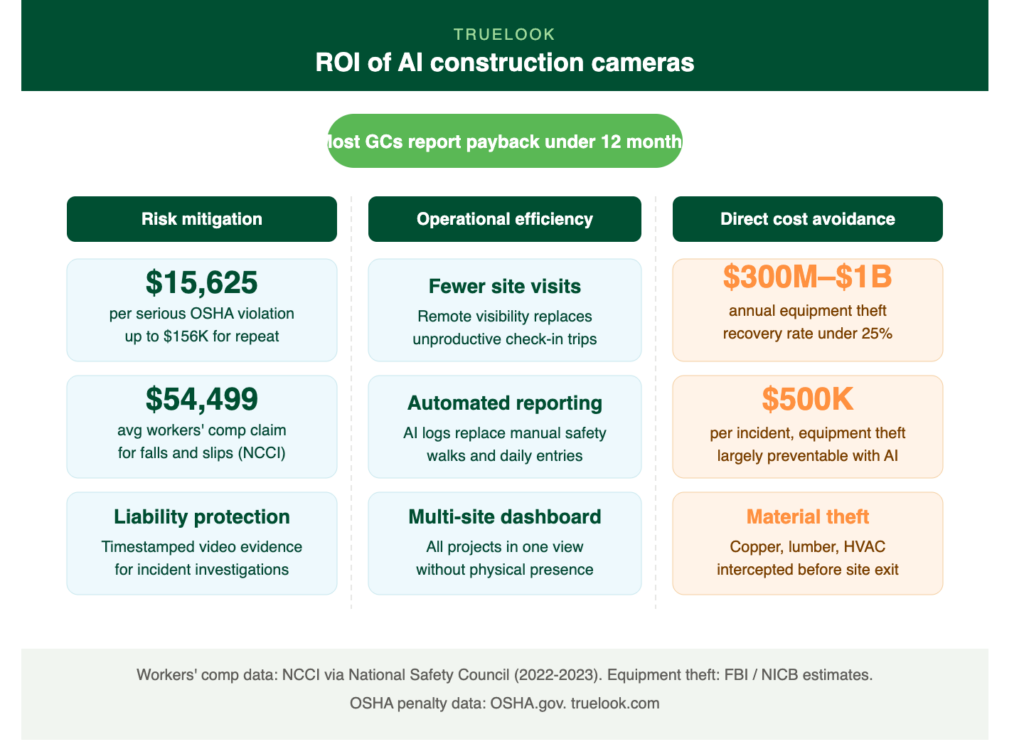
The ROI case for AI cameras on commercial jobsites breaks down into three categories: risk mitigation, operational efficiency, and direct cost avoidance.
Risk Mitigation
- OSHA penalties for serious violations can reach $16,550 per violation. Repeat violations can hit $165,514 per violation. AI cameras that catch and document PPE violations before OSHA does and create a defensible compliance record.
- According to NCCI data via the National Safety Council, the average workers’ compensation claim across all injury types reached $47,316 for accidents occurring in 2022–2023, with falls and slips averaging $54,499 per claim. Proactive hazard detection reduces incident frequency, which directly affects insurance premiums over time.
- Liability exposure from site incidents can far exceed the direct cost of an injury. Video documentation of site conditions provides critical protection in litigation.
Operational Efficiency
- Automated safety reporting reduces the time superintendents spend on manual safety walks and documentation.
- Remote site visibility eliminates unproductive check-in trips. A project manager overseeing three active sites doesn’t need to drive to each one to confirm crew presence and progress.
- AI-generated activity logs support accurate daily reporting without field staff spending time on manual entries.
Direct Cost Avoidance
- Equipment theft, averaging at least $30,000 per incident, is largely preventable with AI-enabled perimeter monitoring and after-hours deterrence.
- Material theft, particularly copper, lumber, and HVAC components, is similarly addressable.
Most commercial GCs running AI cameras on large projects report payback periods under 12 months when factoring in avoided incidents, reduced theft exposure, and labor saved on manual monitoring and reporting.
How to Choose an AI Construction Camera Solution
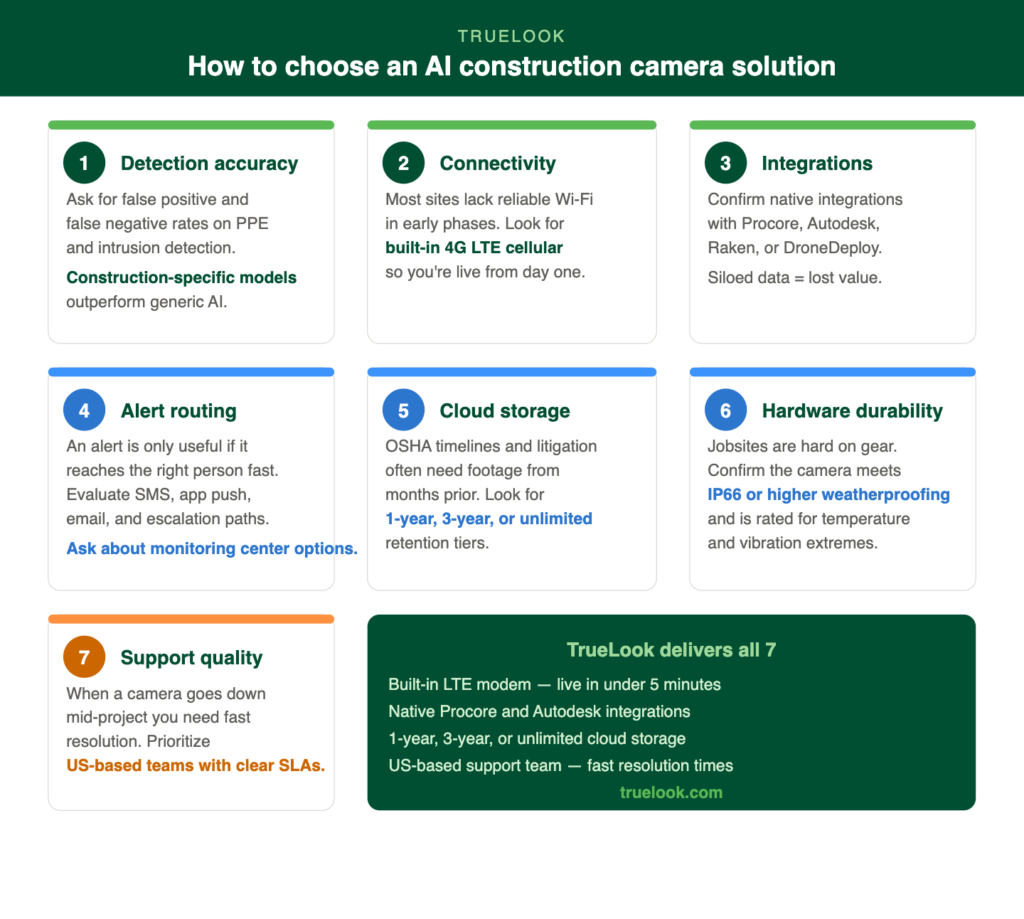
Not all AI camera platforms are built for the demands of an active commercial construction site. Here’s what to evaluate:
1. Detection Accuracy and Model Quality
Ask vendors for their false positive and false negative rates on PPE detection and intrusion events. Generic surveillance AI is not the same as models trained on construction-specific datasets; hard hats, safety vests, and construction equipment require purpose-built training data. Request a demo of footage from a site similar to yours.
2. Connectivity
Most construction sites don’t have reliable Wi-Fi infrastructure, especially in early phases. Look for cameras with built-in 4G LTE cellular connectivity so the system works from day one without requiring a networking buildout. TrueLook cameras include a built-in LTE modem as standard, which is why customers consistently report going live in under 5 minutes.
3. Integration with Your Construction Stack
AI cameras generate data that’s most valuable when it flows into the platforms your team already uses. Look for native integrations with Procore, Autodesk Construction Cloud, Raken, or DroneDeploy so safety events, daily logs, and site photos don’t live in a siloed system.
4. Alert Routing and Response Workflow
An alert is only useful if it reaches the right person fast enough to matter. Evaluate how alerts are delivered (SMS, app push, email, monitoring center dispatch), who receives them, and what the escalation path looks like if no one responds.
5. Cloud Storage and Retention
OSHA recordkeeping requirements and litigation timelines often require video evidence from months or years prior. Confirm what storage retention options are available and what happens to footage when a project closes out. Look for 1-year, 3-year, or unlimited retention tiers depending on your project risk profile.
6. Hardware Durability
Construction sites are hard on equipment with dust, vibration, temperature extremes, and physical hazards. Confirm the camera meets IP66 or higher weatherproofing standards and is rated for the conditions on your sites.
7. Support and Service
When a camera goes down on an active project, you need it resolved fast. Prioritize vendors with US-based support teams, strong reviews for responsiveness, and clear SLAs for hardware replacement. TrueLook’s US-based team is consistently praised for fast resolution times across camera guidance, replacements, and upgrades.
Where TrueLook Fits
TrueLook is a hardware-enabled SaaS platform that combines enterprise-grade construction cameras with AI-driven jobsite intelligence — built specifically for commercial construction PMs who need full-site visibility without being physically on-site.
TrueLook’s AI-driven features include PPE detection, object and vehicle recognition, and smart motion classification — layered on top of live HD viewing, automated time-lapsing, after-hours security monitoring, and a multi-site dashboard that centralizes every project in one interface.
Key differentiators for commercial GCs:
- Built-in 4G LTE modem — live in under 5 minutes, no jobsite Wi-Fi needed
- Native integrations with Procore, Autodesk Construction Cloud, Raken, and DroneDeploy
- US-based support team with outstanding reviews for responsiveness
- Flexible hardware options — lease or purchase, tiered subscription plans
- Cloud storage — 1-year, 3-year, or unlimited retention depending on plan
- Optional professional monitoring — after-hours response through a nationwide monitoring network
Frequently Asked Questions
AI construction cameras are jobsite monitoring systems that use computer vision and machine learning to analyze live video footage in real time. Unlike traditional cameras that only record, AI cameras actively detect events — PPE violations, unauthorized access, equipment movement, hazard zone breaches — and generate automated alerts without requiring someone to watch the feed continuously.
AI cameras can detect PPE compliance violations (missing hard hats, safety vests, fall protection) in real time and alert supervisors immediately rather than waiting for a scheduled safety walk. They also enforce restricted zone boundaries and create automated, timestamped documentation that supports OSHA compliance and incident investigation.
Traditional cameras passively record footage that requires human review to extract useful information. AI cameras actively analyze that footage and generate event-specific alerts — reducing false alarms, eliminating the need for constant manual monitoring, and creating structured safety and security data that traditional cameras can’t produce.
AI cameras use trained object detection models to monitor site perimeters after hours. When a person or vehicle is detected in a restricted area, the system generates an immediate alert to a security contact or remote monitoring center — enabling real-time response rather than discovering theft the next morning. Timestamped footage also significantly improves recovery and prosecution outcomes.
AI PPE detection uses computer vision models trained on construction-specific datasets to identify whether workers are wearing required personal protective equipment — hard hats, safety vests, gloves, safety glasses, and harnesses. The model analyzes video frames in real time and flags non-compliance, creating both an immediate alert and an auditable log of safety conditions.
Not all do. The best solutions for construction include built-in cellular (4G LTE) connectivity so cameras work from day one without requiring a networking infrastructure buildout — critical on early-phase sites where site Wi-Fi doesn’t yet exist. TrueLook cameras include a built-in LTE modem as standard.
Evaluate detection accuracy (especially for PPE and intrusion events), cellular connectivity, integration with platforms like Procore and Autodesk Construction Cloud, alert routing and response workflow, cloud storage retention options, hardware durability ratings, and the quality of vendor support. Construction-specific AI models outperform generic surveillance AI — ask vendors for accuracy data on construction datasets specifically.
ROI comes from three areas: avoided OSHA penalties and workers’ comp costs (risk mitigation), reduced labor on manual monitoring and reporting (operational efficiency), and prevented equipment and material theft (direct cost avoidance). Most commercial GCs running AI cameras on large projects report payback periods under 12 months.
Yes — leading AI construction camera platforms offer native integrations with Procore, Autodesk Construction Cloud, Raken, and DroneDeploy. These integrations allow safety events, daily logs, and site photos to flow directly into the platforms project teams already use rather than living in a siloed system.
AI cameras support OSHA compliance by detecting and documenting PPE violations, creating timestamped records of site conditions, and generating audit trails that demonstrate active safety management. They do not replace the requirement for human safety oversight, but they significantly strengthen a GC’s compliance documentation and incident response capabilities.
Bottom Line
AI construction cameras have moved from novelty to standard practice on commercial jobsites because they solve a problem that manual oversight can’t: real-time detection and documentation across complex, dynamic environments where safety and security events happen faster than any superintendent can respond.
The right system combines construction-specific AI models, cellular connectivity, and integration with the platforms your team already runs. TrueLook delivers all three — with a US-based support team, flexible hardware options, and an AI layer built on top of the industry’s most trusted jobsite camera platform.
Request a quote or demo from TrueLook to see how it works on your projects.