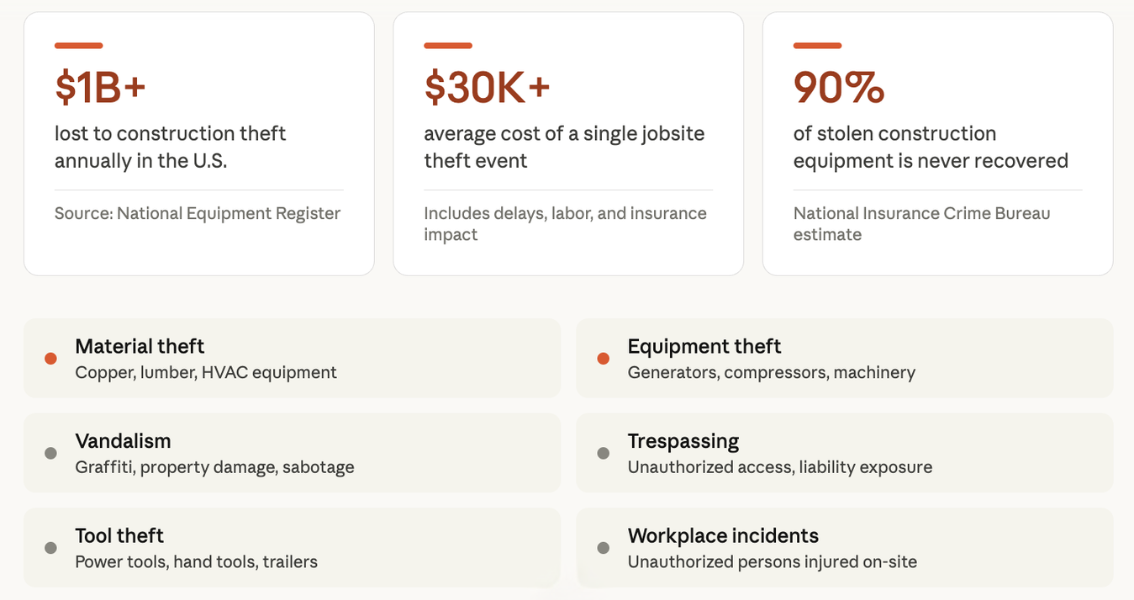
Construction sites are among the most vulnerable targets for theft, vandalism, and unauthorized access. With high-value materials, expensive equipment, and open perimeters, construction site security is one of the most pressing challenges project managers face today. The construction industry loses an estimated $1 billion or more annually to theft alone, and that does not account for project delays, insurance headaches, and the ripple effects on your bottom line.
A comprehensive construction site security strategy goes beyond putting up a fence or installing a single camera. It requires layered systems, proactive monitoring, and the right technology deployed at the right phases of your project.
This guide covers everything you need to know about construction site security, from surveillance cameras and mobile trailers to remote monitoring and jobsite theft prevention, so you can protect your people, your assets, and your project timeline.
Why Construction Sites Need Security
Construction sites present a unique and challenging security environment. Unlike a permanent facility with locked doors, alarm systems, and controlled access, a jobsite is open, constantly changing, and often completely unattended after hours.
Here is what makes construction sites particularly vulnerable:
- Open perimeters — Sites are rarely fully enclosed, especially in early phases
- High-value assets on-site — Copper wire, lumber, HVAC equipment, heavy machinery, and power tools are all attractive targets
- Predictable schedules — Thieves know when crews leave and when sites go dark
- Limited after-hours presence — Most sites have no personnel on-site overnight or on weekends
- Multiple access points — Subcontractors, deliveries, and inspectors create numerous entry opportunities that are difficult to control
- Evolving layouts — As a project progresses, blind spots and coverage gaps constantly shift
The consequences of poor construction site security extend well beyond replacing stolen materials. A single theft event can cause days or weeks of project delays, trigger insurance claims that raise your premiums, damage your relationship with clients, and create liability exposure if trespassers are injured on-site.
The good news is that today’s construction site security systems are more capable, more affordable, and easier to deploy than ever before and the ROI is clear.
Types of Construction Site Security Systems
Effective jobsite protection is not a single product. It is a system of layered solutions working together. Understanding the full range of available construction site security systems helps you build a strategy that matches your project’s size, duration, and risk profile.
Surveillance Cameras – Fixed or mobile cameras covering key areas of the site, including entry points, material staging areas, equipment storage, and perimeter zones. Construction site surveillance cameras are the foundation of most modern security strategies.
Mobile Surveillance Trailers – Self-contained, towable units equipped with cameras, solar power, cellular connectivity, and integrated lighting. Mobile trailers offer flexibility as the jobsite evolves and are ideal for temporary construction site security needs.
Remote Video Monitoring Services – Professional monitoring centers that watch your cameras in real time, respond to alerts, and contact law enforcement when suspicious activity is detected. Far more effective than passive recording alone.
Access Control Systems – Gated entry points with badge readers, PIN pads, or key fobs that limit who can enter and when. Access logs create a record of all site activity.
Perimeter Fencing and Lighting – Physical barriers combined with motion-activated or always-on lighting reduce unauthorized access and deter opportunistic theft. Lighting is one of the most underutilized and cost-effective deterrents available.
Alarm Systems – Motion-activated alarms that trigger alerts to on-call personnel or monitoring centers when unauthorized activity is detected after hours.
GPS Tracking for Equipment – Asset tracking devices installed on heavy equipment, generators, and high-value tools allow for real-time location monitoring and rapid recovery if stolen.
The most effective jobsite security systems combine several of these layers. Cameras alone may deter casual theft, but pairing them with remote monitoring, perimeter control, and lighting creates a defense-in-depth strategy that significantly reduces risk.
Ready to build your security plan? Request a free site assessment from TrueLook’s construction security specialists.
Construction Site Surveillance Cameras
Surveillance cameras are the cornerstone of any construction site security plan. They deter criminal activity, provide documented evidence, and give project managers the ability to monitor site activity remotely from any device.
Types of Construction Site Surveillance Cameras
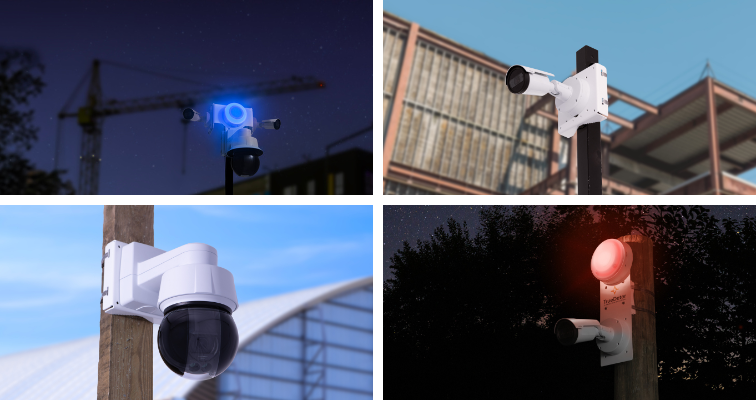
PTZ Cameras (Pan-Tilt-Zoom) – PTZ cameras can be remotely controlled to pan, tilt, and zoom across wide coverage areas. They are ideal for large sites where flexible, responsive coverage is needed from a single mounting point. High-resolution PTZ cameras can capture enough detail to identify individuals or read license plates at significant distances.
Fixed Cameras – These units maximize coverage from a single installation point, minimizing blind spots. They work well at entry and exit points, material staging areas, and the center of active work zones.
Thermal Imaging Cameras – Thermal cameras detect heat signatures rather than relying on visible light, making them highly effective for after-hours perimeter monitoring in complete darkness. They are particularly valuable along fencing lines and access roads.
Solar-Powered Cameras – For sites without electrical infrastructure, solar-powered cameras provide a self-sustaining solution. Modern solar systems store enough energy to operate through several consecutive cloudy days, making them a practical option for early-phase projects or remote locations.
Key Features to Evaluate
When selecting security cameras for construction sites, prioritize these specifications:
- Resolution — 1080p HD minimum; 4K for superior identification detail
- Night vision — IR or full-color night vision for 24/7 coverage
- Weather resistance — IP66 rating or higher for outdoor durability
- Remote access — Cloud-based live and recorded footage via desktop or mobile
- Motion detection and alerts — Automated notifications when activity is detected in defined zones
- Storage — Local NVR, SD card, or cloud-based options
The Power of Pairing Cameras with Monitoring
Construction site surveillance cameras are significantly more effective when integrated with a professional monitoring service. Rather than reviewing footage after a theft has already occurred, live monitoring enables trained operators to intervene in real time, issuing audio warnings, alerting your team, or dispatching law enforcement before an incident escalates.
Mobile Surveillance Trailers for Construction Site Security
For construction sites that need flexible, rapidly deployable security, mobile surveillance trailers are one of the most practical tools available. These self-contained, towable units combine high-definition cameras, solar power, cellular connectivity, and integrated lighting into a single portable structure that can be set up in hours and repositioned as your project evolves.
Mobile trailers are particularly well-suited for sites in early project phases before electrical infrastructure is established, short-duration projects where permanent installation is not cost-justified, and high-risk periods like weekends and holidays when sites are most vulnerable.
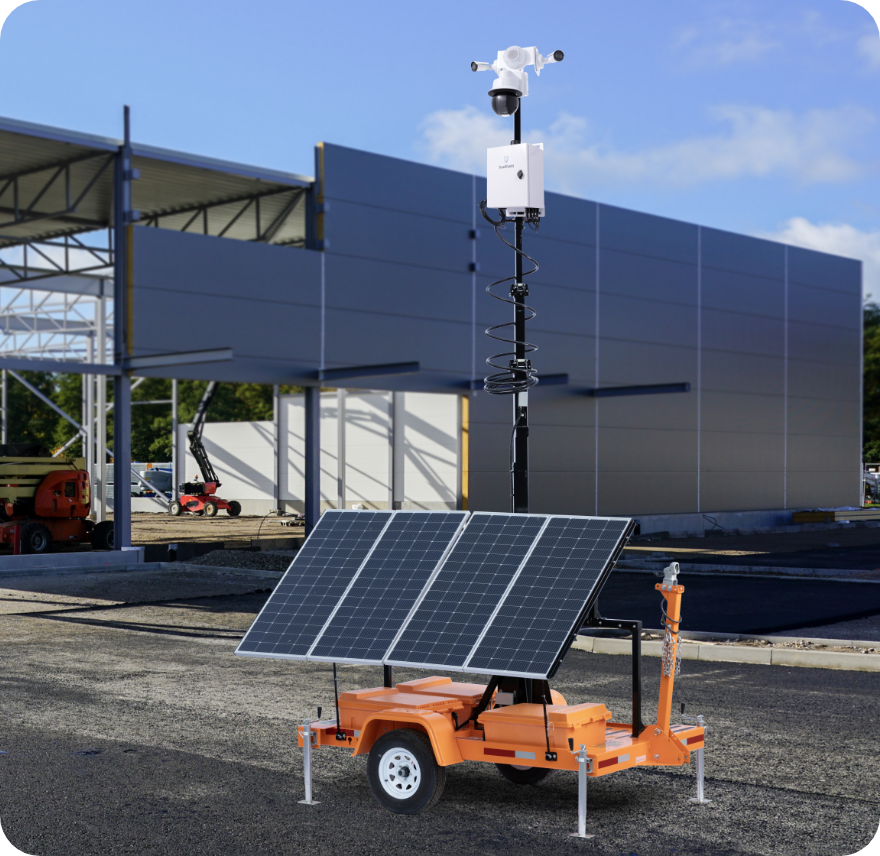
Because they require no hardwiring or permanent installation, they fill coverage gaps that fixed camera systems cannot always address. They are available for both rental and purchase, with solar-powered options making them viable for even the most remote jobsite locations.
For a complete breakdown of trailer types, costs, solar options, and deployment strategies, visit our full guide: Mobile Surveillance Trailers: The Complete Guide
Remote Monitoring Solutions
Cameras record what happens. Remote monitoring stops it from happening in the first place. This distinction is at the heart of why professional video surveillance monitoring services have become a standard component of construction site security for serious project managers.
How Remote Video Monitoring Works
With a professional monitoring service, trained operators watch your construction site surveillance cameras in real time or respond immediately when motion-triggered alerts are activated. When suspicious activity is detected, operators can:
- Issue live audio warnings through on-site speakers, alerting trespassers that they are being watched
- Contact law enforcement with real-time video evidence to support a faster response
- Notify your team or on-call personnel with timestamped documentation
- Log and preserve footage for insurance claims, police reports, or legal proceedings
This model, often called virtual guarding, delivers the responsiveness of an on-site guard at a fraction of the cost.
Learn more about the best ROI for construction site security.
Benefits of Professional Monitoring
- 24/7 coverage with no scheduling gaps or human fatigue
- Faster incident response compared to after-the-fact footage review
- Documented evidence that accelerates insurance claims and investigations
- Scalable across multiple jobsites from a single monitoring platform
- Reduced reliance on costly overnight security personnel
Insurance and Compliance Advantages
Many insurance carriers offer premium reductions for construction projects with active video surveillance monitoring in place. Documented security protocols can also help satisfy builder’s risk insurance requirements and demonstrate due diligence in the event of a claim or dispute.
Want to see it in action? Request a live monitoring demo from TrueLook today.
Temporary Jobsite Security
Not every construction project requires a permanent, long-term security infrastructure. Many projects, from short-duration commercial builds to phased residential developments, need flexible, temporary construction site security solutions that can be deployed quickly and removed just as easily when the project wraps.
When Temporary Security Makes Sense
Temporary security solutions are particularly valuable in these scenarios:
- Early project phases before permanent infrastructure is established
- Short-duration projects where a long-term system is not cost-justified
- Gap coverage during transitions between project phases
- High-risk windows such as weekends, holidays, and periods of material delivery
- Remote or rural sites where power and connectivity infrastructure is limited
Temporary Security Options
Mobile Surveillance Trailers – The most versatile temporary security tool available. Trailers can be on-site and operational within hours, require no permanent installation, and can be relocated as the project footprint changes. Solar-powered units eliminate the need for generator fuel or electrical hookup.
Portable Camera Systems – Standalone camera units that can be mounted on temporary poles, fencing, or existing structures. These are a cost-effective option for targeted coverage of specific high-risk areas.
Temporary Fencing with Security Enhancements – Construction fencing is standard practice, but adding camera mounts, motion-activated lighting, and visible signage transforms a basic perimeter into an active deterrent.
Short-Term Monitoring Contracts – Many security providers offer flexible monitoring agreements aligned to project timelines rather than requiring long-term contracts. This allows project managers to scale security up or down based on active risk periods.
Planning Temporary Security Into Your Project Budget
The most common mistake with temporary construction site security is treating it as an afterthought. The most effective approach is to plan security coverage from pre-construction through project closeout, adjusting the type and level of coverage as the project evolves and risk profiles shift.
Get a full breakdown of temporary security options and how to deploy them effectively: Temporary Construction Site Security: A Project Manager’s Guide
Jobsite Theft Prevention Best Practices
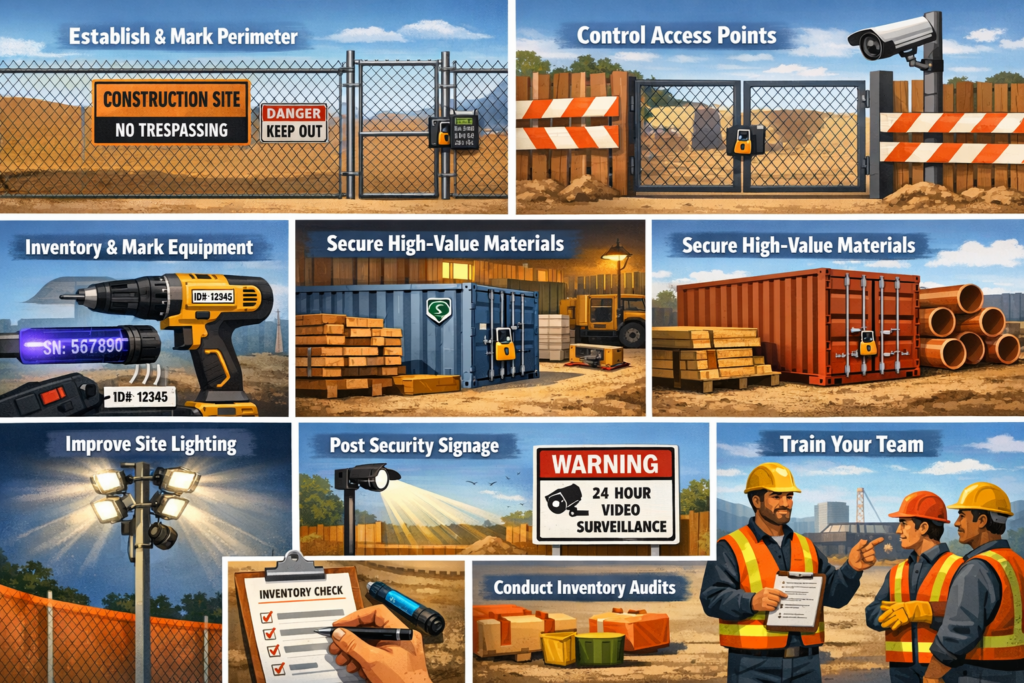
Technology is only part of the equation. The most secure construction sites combine electronic surveillance with strong physical practices and team-wide protocols. Here are proven jobsite theft prevention strategies to implement on your next project:
Establish and Mark Your Perimeter – Use fencing, barriers, and signage to clearly define site boundaries. Visible perimeters signal that the site is actively managed and monitored.
Control Access Points – Limit entry and exit points to what is operationally necessary. Secure all access points after hours with locks, gates, or electronic access control. Cover every entry with construction site security cameras.
Inventory and Mark Equipment – Catalog all tools and equipment with serial numbers and use UV marking or asset tags. Marked equipment is harder to sell, easier to recover, and more likely to be returned when found.
Secure High-Value Materials – Store copper, lumber, HVAC equipment, and other high-value materials in locked containers or secured laydown yards. Schedule deliveries to minimize the time materials sit unattended on-site.
Improve Lighting Across the Site – Well-lit sites are significantly less attractive to thieves. Install motion-activated or always-on lighting at entry points, staging areas, and equipment storage zones.
Post Visible Security Signage – Signs indicating active video surveillance can deter theft before it starts. Many thieves will choose a softer target when they see camera notices prominently posted.
Conduct Regular Inventory Audits – Schedule periodic inventory checks, especially before weekends and holidays when sites are most vulnerable. Early detection of discrepancies can prevent larger losses.
Train Your Entire Team – Every worker on-site should understand security protocols: who to contact, how to report suspicious activity, and what not to leave unsecured at the end of the day.
Construction Site Security ROI: Making the Business Case
Project managers sometimes view construction site security as an added expense. But when you run the numbers, the return on investment for a well-designed security system is compelling, and the cost of not investing is often far greater.
The True Cost of a Single Theft Event
A single jobsite theft incident typically involves:
- Direct replacement costs for stolen materials or equipment
- Project delays while waiting on replacements or repairs
- Increased insurance premiums following a filed claim
- Labor costs for crews unable to work while awaiting materials
- Administrative time for police reports, insurance coordination, and recovery efforts
- Client relationship damage from missed milestones or schedule slippage
The National Equipment Register suggests the average construction theft event costs $30,000 or more when all direct and indirect costs are included. Major equipment theft can easily exceed six figures.
How a Security System Pays for Itself
A professionally deployed and monitored construction site security system typically costs a fraction of a single theft event and it runs every night of the project. Key savings include:
- Theft deterrence — Sites with active monitoring report significantly fewer incidents
- Reduced insurance premiums — Many carriers discount builder’s risk policies for sites with documented surveillance and monitoring programs
- Faster incident resolution — Real-time footage dramatically accelerates insurance claims and law enforcement investigations
- Lower staffing costs — Remote monitoring replaces overnight guards at a fraction of the cost
- Dispute documentation — Camera footage resolves subcontractor disputes, liability claims, and OSHA investigations efficiently
Matching Investment to Risk
For short-duration projects, temporary security solutions like mobile surveillance trailer rentals offer a low upfront cost with predictable monthly billing. For companies managing multiple concurrent projects, owning equipment and integrating it with a monitoring service typically delivers the strongest long-term ROI.
Want a custom cost estimate? Request a free quote from TrueLook and we will help you build a security plan that fits your project budget.
Frequently Asked Questions
What is the best security system for a construction site? The best construction site security system depends on your project’s size, duration, and specific risk factors. For most jobsites, the most effective solution combines high-definition surveillance cameras, a mobile surveillance trailer for flexible coverage, perimeter fencing and lighting, and a professional remote monitoring service. This layered approach addresses both deterrence and rapid incident response. For a detailed breakdown, read our guide on jobsite security systems.
Do construction site cameras work at night? Yes. Modern security cameras for construction sites use infrared night vision or full-color night vision technology to capture clear footage in low-light or zero-light conditions. Solar-powered cameras with integrated IR or LED lighting are particularly effective for after-hours coverage on sites without grid power.
Are solar-powered cameras effective for construction sites? Solar-powered cameras are highly effective, especially for temporary construction site security or early project phases before electrical infrastructure is in place. Modern solar systems include battery backup capable of sustaining operation through multiple cloudy days, making them a practical and increasingly standard choice.
Do security cameras help with builder’s risk insurance? Yes. Many insurance carriers view active video surveillance, especially when paired with a professional monitoring service, as a meaningful risk reduction measure. Documented security systems may help satisfy coverage requirements and support premium discounts. Consult your insurance provider about specific documentation or system requirements for your policy.
What is a mobile surveillance trailer? A mobile surveillance trailer is a towable, self-contained security unit equipped with HD cameras, solar power, cellular connectivity, and integrated lighting. It can be deployed anywhere on a jobsite without hardwiring or permanent installation, making it the most flexible option for temporary construction site security.
How do I prevent theft on a construction site? Effective jobsite theft prevention requires a layered approach: install visible surveillance cameras, use perimeter fencing and controlled access points, secure high-value materials in locked containers, improve site lighting, and work with a remote monitoring service that can respond in real time. Regular inventory audits and crew training on security protocols also significantly reduce theft risk.
Protect Your Jobsite with TrueLook
Construction site security is not an optional line item. It is a project management essential. Theft, vandalism, and unauthorized access cost the industry billions of dollars annually and can derail even the best-planned projects. The right security system protects your assets, keeps your project on schedule, and delivers measurable ROI from day one.
Whether you need a single mobile surveillance trailer for a short-term project or a comprehensive security solution with remote monitoring across multiple locations, TrueLook has the technology and expertise to protect your jobsite around the clock.
Explore TrueLook’s Solutions:
- Construction Site Security Cameras — Learn More
- Mobile Surveillance Trailers — View Options
- Remote Video Monitoring Service — Request a Demo
- Solar-Powered Security Cameras — See How They Work
Ready to get started? Request a free quote from TrueLook and find out how we can protect your next project from the ground up.